Remember when you used to wait for hours to download a single movie? Or when streaming a video meant constant buffering and pixelated quality? Yeah, those were rough times. We’ve come a long way since then, and a huge part of that progress is thanks to video codecs—the unsung heroes working behind the scenes to make your streaming experience smooth as butter.
But here’s where things get really interesting. Just when AV1 was starting to gain traction, its successor—AV2—was already making waves. And trust me, this isn’t just another incremental update. We’re talking about a codec that promises to revolutionize how we stream, store, and consume video content.
In this blog, we will dive into the details of AV1 and AV2.
What Exactly Is a Video Codec?
Video codecs squeeze massive amounts of data into smaller, more manageable sizes without ruining the quality.
Here’s the thing: raw, uncompressed video files are huge. We’re talking hundreds of gigabytes for just a few minutes of 4K footage. Without codecs, streaming services like Netflix or YouTube simply wouldn’t exist. Your internet connection couldn’t handle it, and storage would cost a fortune.
So codecs compress (encode) videos for storage and streaming, then decompress (decode) them when you watch. The better the codec, the smaller the file size with less quality loss.
The Rise of AV1
Before we talk about AV2, we need to understand where AV1 came from. Back in 2015, some of the biggest names in tech—Google, Netflix, Amazon, Microsoft, Apple, Intel, Samsung, and others—formed the Alliance for Open Media (AOMedia) with the mission of creating a next-generation video codec that was:
- Royalty-free: No licensing fees (looking at you, HEVC/H.265!)
- High-performing: Better compression than existing codecs
- Open-source: Available for anyone to use and improve
In 2018, they delivered: AV1 (AOMedia Video 1) was born.
AV1 was designed to be the successor to VP9 (Google’s codec) and a direct competitor to HEVC. The results were impressive—AV1 offered about 30% better compression efficiency than VP9 and HEVC, and a whopping 50% improvement over the older H.264 standard.
In simple terms it meant that you could stream the same quality video using 30% less bandwidth. For streaming giants like Netflix and YouTube, this translates to massive savings in bandwidth costs. For users, it means less buffering, smoother playback, and the ability to stream high-quality video even on slower connections.
Features of AV1:
AV1 came packed with features like:
- Support for up to 8K resolution at 120fps
- HDR and wide color gamut support for those stunning visuals
- 10-bit and 12-bit color depth for more detailed color reproduction
- Real-time encoding capabilities for live streaming and video conferencing
- Royalty-free licensing
- Optimized for internet streaming with features specifically designed for web delivery
The AV1 Adoption Journey
Now, AV1’s journey to mainstream adoption hasn’t been a straight line. Like any new technology, it faced some growing pains.
AV1 encoding is computationally intensive. It requires serious processing power, which initially made real-time encoding difficult and expensive. While decoding (playback) was manageable, encoding took significantly longer than older codecs.
Despite these challenges, AV1 has been steadily gaining ground. By 2024, it’s become the codec of choice for many streaming platforms, especially for high-resolution content.
What is AV2?
In 2020, development began on AV2—and the goals were ambitious.
The Alliance set out to create a codec that would:
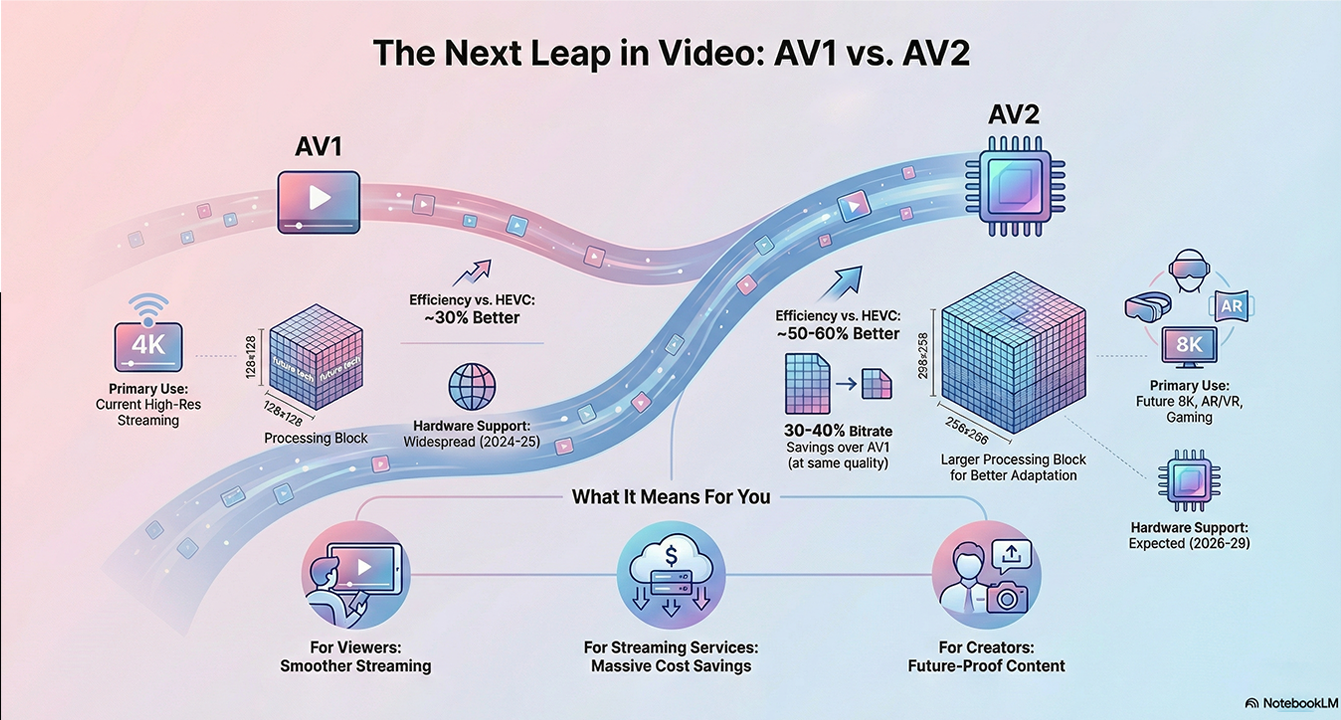
- Deliver approximately 30-40% better compression than AV1
- Keep decoder complexity reasonable
- Support emerging technologies like AR/VR, 8K streaming, and immersive formats
- Maintain the royalty-free, open-source model
What Makes AV2 Special?
AV2 is a significant technological leap from AV1 that introduces several crucial improvements:
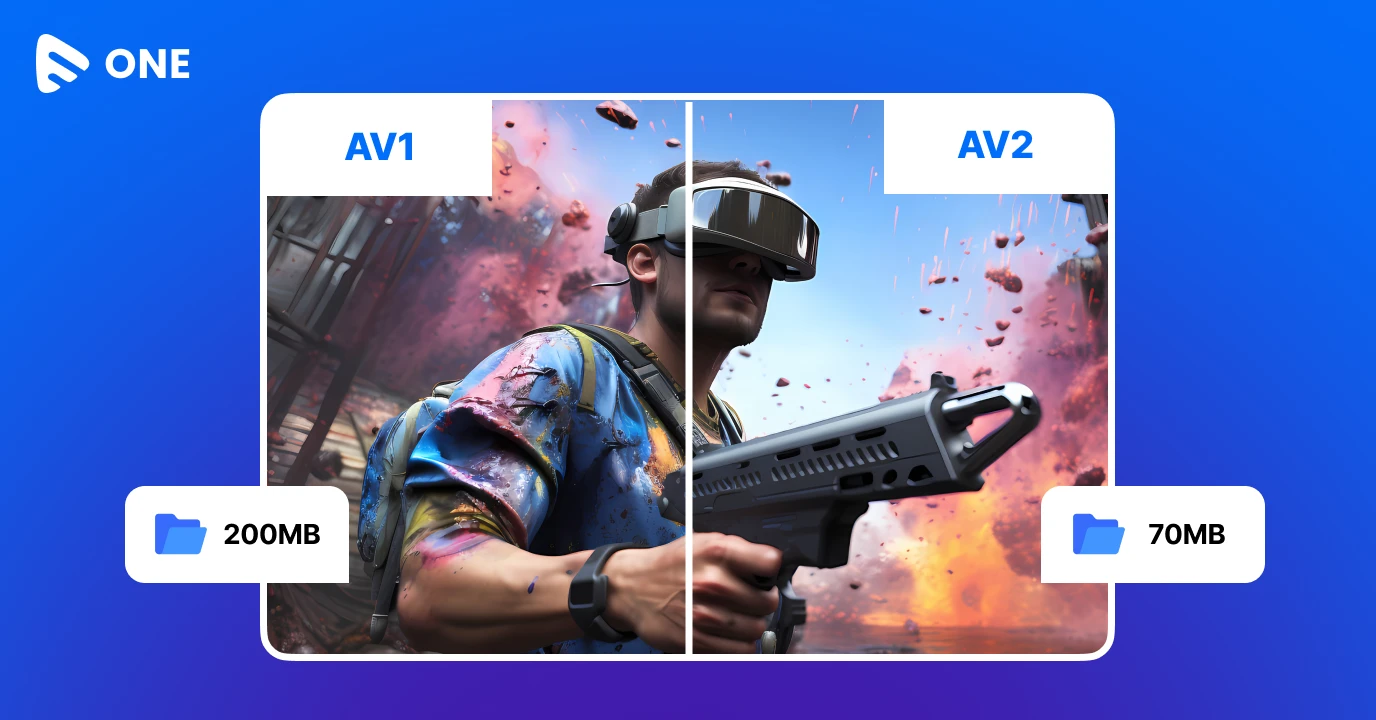
- Dramatically Better Compression Early tests show AV2 achieving around 30% bitrate reduction compared to AV1 at equivalent quality levels. Some metrics even show up to 38% improvement.
For a 4K stream that currently needs 25 Mbps with AV1, you might only need 17.5 Mbps with AV2.
- Smarter Block Processing: AV2 introduces larger superblocks (up to 256×256 pixels, compared to AV1’s 128×128 maximum) with fully recursive partitioning. This allows for better adaptation to different types of content—from static scenes to fast-moving action sequences.
- Advanced Prediction Techniques: The codec uses new data-driven intra modes and improved chroma-from-luma modeling. It can reference up to seven past frames for better motion prediction, compared to AV1’s approach. Also, the Temporal Interpolation Prediction (TIP) that’s in AV2 significantly improves handling of high-resolution or fast-moving scenes.
- Better Quantization: AV2 introduces a unified exponential quantizer with wider range and more precision for 8-bit, 10-bit, and 12-bit video. Trellis-coded quantization and user-defined matrices give encoders better control, especially at lower bitrates where every bit counts.
- Enhanced Filtering: The new generalized deblocking filter preserves more detail while removing compression artifacts. Additional filters like the Guided Detail Filter and Cross-Component Sample Offset further clean up compression noise without blurring important details.
- Native HLS Output: AV2 provides direct HLS (HTTP Live Streaming) output, making it seamless to integrate with existing streaming infrastructure.
- Extended Format Support AV2 is built for the future with enhanced support for:
- AR/VR applications
- Split-screen delivery of multiple programs
- Improved screen content handling (perfect for remote work and presentations)
- Multi-layer and stereoscopic video designs
- Wider visual quality range
AV1 vs AV2: Which is Best for Streaming
Let us break down the key differences between AV1 vs AV2:
Feature | AV1 | AV2 |
Compression Efficiency vs HEVC | ~30% better | ~50-60% better |
Compression Efficiency (vs each other) | Baseline | 30-40% better than AV1 |
Maximum Superblock Size | 128×128 pixels | 256×256 pixels |
Reference Frames | Limited set | Up to 7 frames with ranked selection |
Temporal Interpolation | No | Yes |
Quantization | Standard approach | Unified exponential with wider precision |
Transform System | Advanced | Enhanced with learned & cross-component transforms |
Deblocking Filter | Separate filters | Unified generalized filter |
Additional Filters | Loop filters | Guided Detail Filter, Cross-Component Sample Offset |
AR/VR Support | Basic | Enhanced native support |
Split-Screen Multi-Program | Limited | Native support |
Hardware Complexity | 1x | <2x (validated for efficient implementation) |
Encoding Speed | Slower than H.264/HEVC | Requires optimization (in progress) |
Decoding Speed | Moderate | Designed to be hardware-friendly |
AR/VR Support | Basic | Enhanced native support |
Breaking Down What This Means for Real-World Use
Numbers and technical specs are great, but let’s talk about what these differences actually mean when you’re watching videos:
For Streaming Services
For Biggies like Netflix and Disney+, the biggest expense after content creation is bandwidth—delivering millions of hours of video to viewers worldwide every day.
With AV1, you’re already saving 30% on bandwidth compared to older codecs. But with AV2’s additional 30% improvement over AV1, you’re looking at roughly 50-60% total savings compared to HEVC. For a company streaming billions of hours annually, this translates to billions of dollars in infrastructure cost savings.
For Content Creators
If you’re uploading videos to YouTube or running your own streaming platform, AV2 means:
- Faster upload times
- Reduced storage costs for your video library
- Better quality at the same file size, or same quality at smaller file sizes
- Future-proofing for 8K and beyond
For Viewers
For end-users binging on OTT platforms, AV2 provides:
- Smoother streaming on slower connections
- Higher quality at the same bandwidthLess data usage
- Better battery life
For Businesses and Enterprises
If you’re running corporate training platforms, video conferencing, or managing large video libraries:
- Massive storage savings:
- Reduced CDN costs
- Better remote work experience
- Enhanced AR/VR capabilities
How AV1 Works
Here is a detailed explanation of how AV1 works:
Step 1: Partitioning– The encoder breaks each video frame into blocks (superblocks up to 128×128 pixels)
Step 2: Prediction– AV2 looks at previous frames and tries to predict what the next frame will look like
Step 3:Transform– The differences between prediction and reality are converted using mathematical transforms
Step 4: Quantization– Less important details are simplified to save space
Step 5: Entropy Coding– The final data is compressed using advanced algorithms
Step 6: Filtering– Artifacts are cleaned up to maintain visual quality
How AV2 Improves on This
AV2 keeps the same basic hybrid block-based structure but enhances every single step:
- Larger superblocks (256×256) allow better handling of large uniform areas
- Fully recursive partitioning adapts better to content complexity
- Smarter luma/chroma split separation improves color accuracy
- More reference frames provide better temporal prediction
- Learned transforms adapt to content characteristics
- Better filtering preserves detail while removing artifacts
The Future of AV2 Codec
Here’s what makes AV2 particularly exciting: it’s not just a better codec—it’s built for the future we’re heading into.
8K and Beyond: While most of us are still getting comfortable with 4K, 8K content is coming. AV2 handles it efficiently.
AR/VR Revolution: As augmented and virtual reality become mainstream, the bandwidth requirements are massive. AV2’s optimizations make immersive experiences more accessible.
Cloud Gaming: Streaming games requires ultra-low latency and high quality. Better codecs directly improve the gaming experience.
Remote Work: As video conferencing becomes more sophisticated (think holographic meetings), efficient compression becomes critical.
AI-Generated Content: As AI creates more video content, efficient codecs help manage the explosion of content volume.
What This Means for Video Platform Owners
If you’re running a video streaming platform, e-learning portal, or managing corporate video infrastructure, understanding these codecs isn’t just academic—it directly impacts your bottom line and user experience.
This is where platforms like Muvi One become essential. Here’s why:
The codec landscape is constantly evolving, and managing video infrastructure can be complex and expensive. You need a platform that:
- Stays ahead of codec evolution: Automatically supports the latest codecs without requiring you to manage technical infrastructure
- Optimizes automatically: Intelligently selects the best codec for each viewer based on their device and connection
- Reduces costs: Better compression means lower storage and bandwidth expenses
- Maintains quality: Ensures your content looks great regardless of viewing conditions
- Scales effortlessly: Handles everything from HD to 8K as your needs grow
Building Your Video Future with Muvi One
Whether you’re launching an OTT platform, running corporate training programs, or building the next big streaming service, having the right technology partner makes all the difference.
Muvi One provides a complete, future-ready video streaming solution that takes the complexity out of codec management and infrastructure:
Multi-Format Support
Muvi One automatically handles multiple codecs including AV1, with plans to support AV2 as it becomes available. Your content is automatically encoded in the formats that work best for each viewer’s device and connection.
Intelligent Adaptive Streaming
The platform automatically switches between codecs and quality levels in real-time based on bandwidth availability, ensuring smooth playback without buffering.
Cost-Effective Infrastructure
With smart codec selection and efficient CDN integration, Muvi One helps you minimize bandwidth and storage costs while maintaining exceptional quality.
White-Labeled Everything
Launch your own branded streaming platform—web, mobile, and TV apps—without worrying about the underlying technical complexity of video encoding and delivery.
Comprehensive Monetization
Whether you want SVOD, TVOD, AVOD, or hybrid models, Muvi One supports them all with seamless integration.
Built-In Analytics
Understand how your content performs with detailed analytics on viewer engagement, quality of experience, and bandwidth usage.
Enterprise-Grade Security
DRM protection, watermarking, geo-restrictions, and advanced user management keep your content secure across all platforms.
Scalability for Growth
Start small and scale to millions of viewers without changing platforms or rebuilding infrastructure.
The Bottom Line
The evolution from AV1 to AV2 represents a massive leap forward in video technology. We’re talking about roughly 50-60% better compression compared to HEVC, which has dominated the market for years. This isn’t just incremental improvement—it’s transformative.
For viewers, this means a better streaming experience with less buffering and lower data usage. For businesses, it means significant cost savings and the ability to deliver higher-quality experiences.
The codec wars aren’t really about AV1 Vs AV2—they’re about continuous improvement in how we deliver video content. AV1 laid an incredible foundation, and AV2 is building something even more impressive on top of it.
And the best part? Both are royalty-free and open-source, which means innovation continues without the burden of licensing fees that have held back codec adoption in the past.
Ready to Future-Proof Your Video Platform?
Try Muvi One free for 14 days and see how easy it is to launch a professional-grade video streaming platform that’s ready for upcoming technical innovations.
Start Your Free Trial!
Have questions about how AV1, AV2, or video codecs impact your specific use case? Our team of streaming experts is here to help. Reach out and let’s talk about building the perfect video solution for your needs.









Add your comment