The OTT streaming industry is no longer just streaming videos from point A to point B. With the introduction of AI, streaming today needs personalization, intelligence, automation, and some real-time decision-making to make it more efficient than before. From AI-powered recommendations to automated content moderation and monitoring, streaming is extremely AI-driven and requires massive processing power.
At the very core of this evolution in streaming is a dependency on 3 primary computing engines, which are CPU, GPU, and TPU. This blog talks about all of them, their contribution and how these technologies work at the foundation level. Optimal use of computing engines ensures smooth integration of artificial intelligence in the streaming workflows.
Why Processing Power Matters in Streaming
As said before, modern streaming platforms are not video players but massive data factories. Every second, they are ingesting, analyzing, and processing massive amounts of video and user data, often simultaneously to millions of users across the globe.
Unlike static websites or traditional media, streaming therefore demands more processing power due to its continuous computation requirements and possibly zero to very minimal tolerance towards delay or failure. Let’s start with the basics. Content has to be encoded to multiple formats. This also involves converting law files to multiple resolutions and bitrates to suit different devices based on network conditions.
Next, post encoding, there is playback optimization. Streaming platforms have to constantly monitor network conditions, device capabilities, and dynamically adjust the video quality. This has to happen in milliseconds to ensure lagfree content streaming experience for the end user.
That was video delivery but processing power is required even beyond that. Streaming generates millions of crucial data points. From watch times, drop-off points, content preferences, interaction pattern and more contribute to understanding the user. These insights power personalization engines and have to process large data streams. All of this further increases the demand for processing power.
As AI becomes central to streaming experiences, AI-based recommendation engines have moved from being optional features to core platform components. These models continuously learn from user behavior and content metadata to surface the right content at the right time. Running such models in real time demands far more computational efficiency than traditional rule-based systems.
Lastly, processing is also critical for content security and DRM. Content encryption, license validation, tokenized access, and anti-piracy checks must occur with minimal delay, too. All this has to happen even during peak hours, and any delay in these processes can lead to failed playback and security vulnerabilities.
As AI-driven automation, personalization, and real-time intelligence become deeper parts of streaming workflows, platforms can no longer rely on general-purpose computing alone. They need faster, more specialized processing units that can handle parallel workloads efficiently and scale dynamically without inflating operational costs. This is where CPTs, GPUs, and TPUs come into play.
Understanding the Basics: CPU, GPU, and TPU
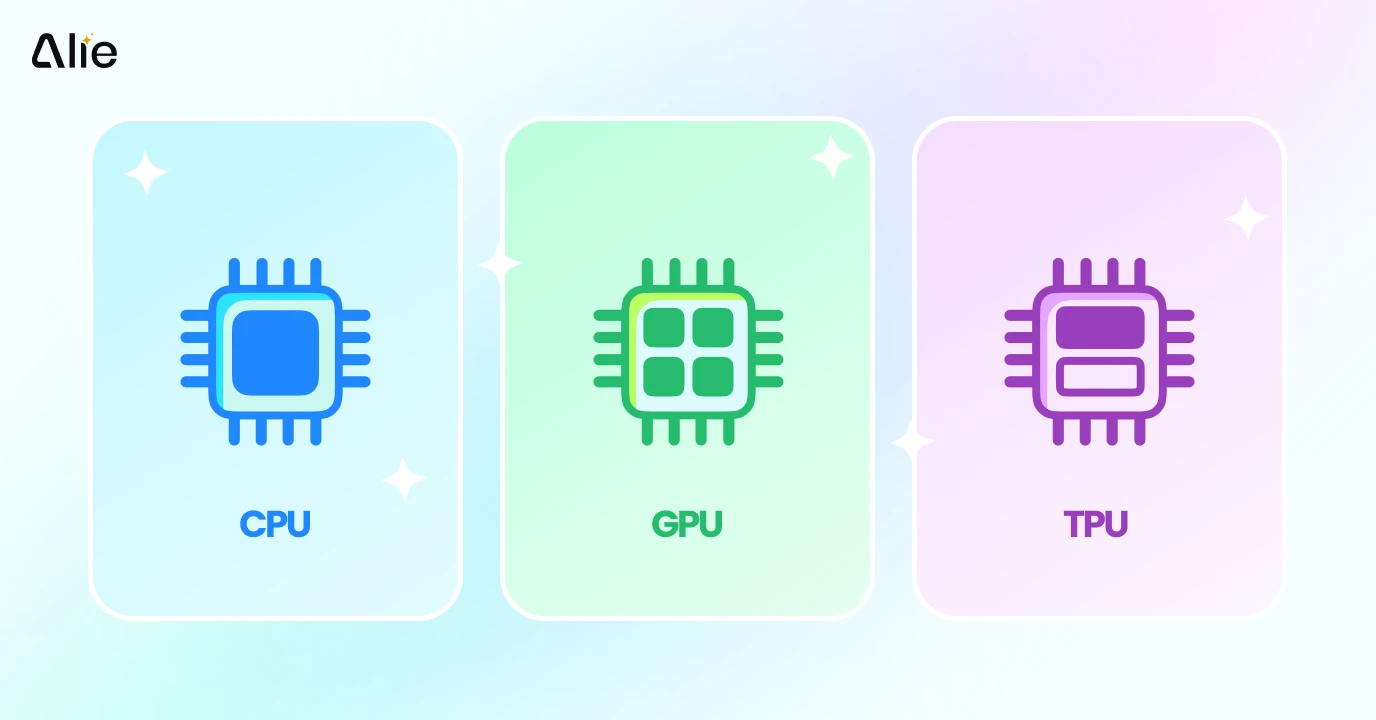
Processing units today are defined into 3 main parts. They are the central processing units or the main brain of any computer or streaming device. The graphics processing unit, or GPU which is built for parallel processing and rendering graphics at a much larger scale. Lastly comes the tensor processing unit or TPUs, which are specialized processors built for machine learning. Let us understand them one by one.
Central Processing Unit or CPU
CPU is the foundation of any computing system and is the backbone of any modern streaming platform. Often called the brain of any computer system, it is designed to execute a variety of instructions with precision. In streaming environments, where multiple systems must work together seamlessly, the CPU acts as the central coordinator that keeps everything running smoothly.
CPUs are responsible for handling a platform’s core operations and workflows. They handle application logic and backend services to ensure essential platform functions are always up and running. From user authentication, account management, to ensuring the right API requests are fetched, CPU ensures basic video orchestration tasks are in place.
Though CPUs can run streaming platforms, they are not designed to handle intensive AI demands and large scale graphic intensive video processing. They therefore become inefficient during large-scale video processing.
Graphics Processing Unit or GPU
GPUs are built for parallel processing and to perform tasks that require higher computational power, such as rendering complex simulations in real-time. GPUs are exceptionally powerful for video workloads and artificial intelligence. In streaming ecosystems, GPUs dramatically improve video performance and scalability. They accelerate video encoding and transcoding by processing multiple frames simultaneously, allowing platforms to deliver HD and 4K content efficiently across devices and network conditions.
GPUs help minimize latency by speeding up encoding, packaging, and delivery workflows. Beyond video, GPUs enable AI-driven features such as recommendation engines, computer vision–based content moderation, facial or object recognition, and real-time viewer analytics. They consume higher power than CPUs and tend to cost more compared to GPUs, but they are the ones that make high-quality video processing possible, especially during peak hours and live streaming.
Tensor Processing Units or TPUs
We are enjoying the dawn of AI, and if there is one line of processors that has made AI as good as it is today, it is TPUs that are specially built for machine learning ,assessing particularly deep neural networks. Unlike CPUs and GPUs, tensor processing units exist to execute AI workflows faster and more efficiently.
Advanced personalization models, predictive analytics for churn and engagement, and AI-driven ad targeting can all benefit from TPU-level efficiency. While TPUs are still emerging in mainstream streaming infrastructure, they are increasingly relevant as platforms shift toward intelligence-led experiences.
TPUs power recommendation engines and are responsible for managing massive data sets and making computational decisions that make the streaming experience more personalized for the end user.
How Better Processing Power Enables AI in Streaming
Now that you know what part of a processor does what, you know that in today’s times, all three of them are used if you want to build a modern Netflix-like streaming service that is constantly up and running and every profile feels personalized. At the end of the day, it’s all about how much processing juice you are giving to your system and this gives several advantages for streaming platforms across the streaming cycle.
Smarter Content Recommendation
Modern AI engines analyze vast amounts of data, such as viewing history, watch duration, time of day, device type, and geographic location, to suggest highly relevant content. Efficient GPUs and TPUs enable recommendation models to learn faster and respond in real time, making content personalization feel more human. It’s almost like a user having a virtual friend taking a careful note of what the user likes, using that data, and comparing with thousands of other users and pulling out the next likable content like a magician.
Improved Content Moderation
A piece of content has to go through several countries, each with its own set of laws about what can be viewed and what cannot. When massive amounts of content are generated, particularly for the UGC platforms, it’s crucial how inappropriate content is detected. High-performance GPUs and AI accelerators make large-scale, near-real-time moderation achievable, reducing manual effort and improving platform safety. Using computer vision and machine learning models, they can automatically detect inappropriate visuals, copyrighted material, or policy violations within video frames.
Real-Time Content Optimization
AI models are capable of monitoring crucial streaming parameters such as network conditions, viewer devices, buffer health, and dynamically adjust bitrates and resolutions. This contributes to smooth playback and minimal buffering of content.
AI-Driven Video Intelligence
Everybody knows about the massive capabilities of AI. Facebook gives multi-audio for its short-form videos, and that has been achieved purely via AI. Now you can watch a video in your own language, and the model, though not perfect, is improving with time. AI can understand video content through speech-to-text, object recognition, and contextual analysis. This allows viewers to discover content more intuitively, using natural language or even visual cues.
So these are the 4 most important things that happen when processing power improves. The future of streaming is great, and with the right GPUs and TPUs in place, the market will grow better, and the services to the customers will also enhance significantly.
How Muvi Leverages This Computing Evolution
Muvi and its suite of streaming products are at the forefront of the AI revolution. Muvi is leveraging high processing power to develop tools that have the potential to revolutionize the streaming industry and how people consume content. Here are a few amazing things that are now possible with Muvi Products.
TrueComply
Content detection need not be completely manual. With TrueComply, you can detect policy violations, automate review operations, and make the lives of your team a little easier while adding an extra layer of compliance. This ensures that your content is as per the laws of the land even before it ships. From offering masked graphic content to putting sponsorship labels, checking copyright and S&P practices, TrueComply upholds ethical, legal, and audience safety standards at scale.
Suggest IQ
Suggest IQ is Muvi’s AI-powered recommendation engine that can offer a whole new level of personalization by delivering product, content, and search recommendations for your business. More than just the videos, Suggest IQ can be used as a recommendation system for your home page, feature pages, product detail page, and much more. Suggest IQ offers advanced AI-powered personalized suggestions to each user across websites and applications.
Alie AI
Alie AI is the world’s first AI engine that is designed for streaming. Gone are the days when subtitles were manually written. Today, with Alie A,I you can generate accurate subtitles for all your videos instantly. With support for formats such as SRT and VTT, you can generate subtitles for more than 130+ languages. The story does not stop here. ALIE AI does the following for you to make your team’s tasks easier.
Thats not all. Alie AI and all other AI offerings by Muvi are streaming-specific AI solutions that make running massive amounts of content hassle-free and efficient. Get a free 14-day trial to learn more about Muvi’s AI products and how they can help you improve your streaming workflows.









Add your comment