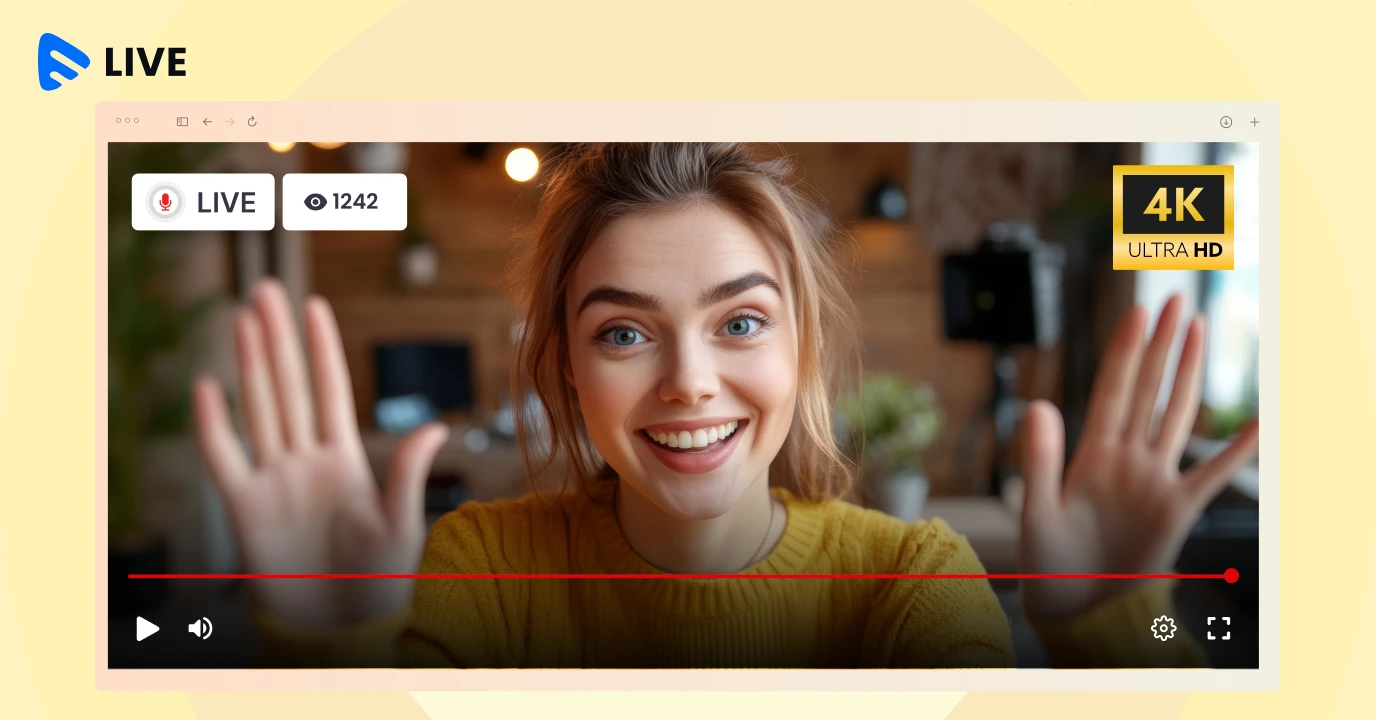
Live streaming is one of the most powerful ways to connect with audiences globally. Weather its entertainment, educational, or simply sales, live streams have proved to be a very efficient way to communicate. However, with the increase in internet speeds, viewers now expect HD live streaming as the baseline. Sharp visuals, smooth playback, and minimal latency are the basic needs of any live streaming audience. In this blog, we are going to show you how you can launch powerful HD live streams using Muvi Live.
Video resolution, as said before, is an essential feature that can enhance any video-watching experience, with live streams being no exception. Live broadcasts, however, are a little more complicated than pre-recorded videos, and therefore, with the technology changes. Achieving high-quality HD live streaming depends on multiple factors such as encoding, bandwidth, software solution, and more.
In this blog, we are going to show you how you can launch powerful HD live streams using Muvi Live. But first, let’s understand more about HD live streams.
What is HD Live Streaming?
HD live streaming refers to broadcasting of live content over the internet at a high-definition revolution which is typically either 720p or 1080p, which is also known as FullHD. High definition resolution obviously offers sharper video quality that includes more details than standard video resolution can capture at 480p.
Anything beyond HD like 4K and 8K, falls into the ultra high definition category. So the question that arises is which resolution is perfect for live streaming, and why not simply go for the highest possible resolution?
While higher formats exist, HD still remains the most practical choice for live streaming today as it effectively balances bandwidth efficiency and video quality. This finally delivers great live video streaming experiences across devices and variable internet speeds.
HD live streaming is widely used across industries because of its professional output and scalability. It is commonly adopted for sports broadcasts, corporate events, webinars, online education, product launches, religious services, and live entertainment. The high visual clarity makes it especially effective for presentations, on-screen text, demonstrations, and real-time interactions with audiences.
HD Live Streaming Vs 4K Live Streaming: Why is the former better?
HD live streaming and 4k live streaming differ primarily in resolution to the end audience. However, to a broadcaster like you, significant differences arise in infrastructure requirements and eventually the costs. HD is the industrial standard because today, a majority of devices all over the globe are compatible with this resolution. 4K, on the other hand, is still a luxury and not all devices support 4K live streaming access. Internet bandwidth is another reason why HD live streams are better.
From an infrastructure standpoint, HD live streaming is significantly more efficient. It requires lower bandwidth, less powerful encoding hardware, and reduced storage and CDN costs. This makes HD streaming more reliable, particularly in regions with inconsistent internet connectivity or for audiences using mobile data. 4K live streaming, on the other hand, demands very high upload speeds, advanced cameras, powerful encoders, and a robust delivery network. Even then, many end-user devices and networks are not fully optimized to consume 4K live streams without interruptions.
Why Should Businesses Stick to HD Live Streaming?
We see here that HD live streaming is globally compatible, maintains good quality visuals, and is less heavy on bandwidth. Thats the answer to the question in 1 line. However, here area few more reasons why HD Live streaming is the best resolution for business and, in many ways, best for the audience as well.
Higher Device Compatibility
Look at all the devices near you. Almost all of them, including the phone screen, tablet, and laptop screen, are HD compatible. Most laptops usually come witha minimum 720p resolution. While 4K is growing in popularity, HD still remains the base for most parts of the world. Therefore, launching streams in HD will give you a larger audience. A larger audience usually means more money.
Bonus Tip: You can stream in 4K, but if the end device on which the content is being streamed is 720p max, it will be streamed at 720p only.
Faster Internet Speeds
Streaming in 4K needs upwards of 15Mbps speeds. HD, on the other hand, can even stream at as low as 3-5 Mbps. Therefore, HD live streams will work even with basic internet connections, and since they will consume less data, users are more likely to stream in HD while they are on the go on mobile devices.
Advanced Encoding Needs
HD live streaming requires significantly less processing power to encode in real time. Standard software encoders and mid-range hardware encoders are sufficient to deliver smooth 720p or 1080p streams using widely supported codecs such as H.264. This makes HD encoding more accessible, cost-effective, and easier to manage, even for long-duration live events. 4K live streams, on the other hand places heavy demands on encoding infrastructure. Encoding 4K video in real time requires high-end cameras, powerful CPUs or dedicated hardware encoders, advanced GPUs, and optimized compression workflows.
How to Launch HD Live Streams?
Launching live streams in HD is much easier today, thanks to much faster internet speeds than 5 years ago. However, even with a robust live streaming platform in place, the final quality of the live stream depends on how well your live streams are configured. So, from network readiness to the right production setup, everything plays a role in launching successful live streams. Here are a few important things that you must ensure are properly configured before you Go Live.
Ensure Sufficient Bandwidth
Live streaming, unlike the usual streaming of pre-recorded content, is heavy on the internet, and a faster internet connection is required to keep it smooth and professional. Always opt for an internet connection with higher internet speeds and possibly double the bitrate of your stream. This ensures fewer network fluctuations, prevents frame drops, and maintains a consistent framerate throughout the live stream.
Right Choice of Equipment
The production is only as good as the quality of equipments that you use. Make sure that the cameras that you use are natively HD supported. Dedicated video cameras like DSLRs provide an edge in video quality.
Bad video is sometimes ignored, but bad audio quality can surely ruin your streaming experience. External microphones, such as lapel, condenser, or directional mics, ensure clear and professional sound.
Lastly, keep the lighting right. Make sure live streams are well-lit to eliminate grains, improve skin tones, and elevate video quality.
Optimize Encoding Settings
Configure the correct resolution, frame rate, and bitrate based on your use case. Most HD live streams perform well at 30fps or 60fps, depending on motion intensity. Avoid excessive compression, as over-compressed streams often result in motion blur, artifacts, and pixelation, especially during fast-moving scenes.
Lastly and most importantly, always test before you go live.
Go Live Effortlessly with Muvi Live
We have talked so much about the things needed to have a proper live stream. However, we have skipped one very crucial thing till now, which is the choice of live streaming software. While the internet is flooded with various live software solutions, we would suggest you try Muvi LIve once.
Muvi Live brings together reliability, scalability, monetization, and analytics, making it easier than ever to broadcast high-quality live streams to global audiences. Whether you’re hosting events, educating learners, or entertaining viewers, HD live streaming with Muvi Live ensures your message is delivered clearly, consistently, and professionally.
5 Reasons Muvi Live is Best for HD Live Streaming
Costs
Muvi Live is extremely accessible to its customers with plans starting as low as US$ 84 per month that include all types of monetization and dedicated HD live streaming support.
Global Content Delivery Infrastructure
Muvi Live offers global live stream delivery thanks to its AWS-backed secure live streaming across the globe. Muvi also deploys stringent security measures to safeguard your streams from DDoS attacks.
Dedicated Live App
Do you have just a mobile camera? No worries! With Muvi Live, you can start live streaming instantly via the Muvi Live app. Simply install and start streaming on both Android and iOS devices.
Multiple Monetization Support
With Muvi Live, you can insert VAST-based ads from any 3rd party Ad Server directly into your live streams. Want to go PPV? You can launch gated PPV content and keep 90% of your earnings.
Live SDK & Webhooks
Integrate live broadcasting capability or build a live streaming app from the ground up using a suite of SDKs and APIs for any platform. Set triggers for starts, stops, creations, updates, and deletions to enable your systems to instantly respond to changes, eliminating the latency and overhead tied to frequent polling of APIs.
Final Words
HD live streaming has become a standard expectation for audiences worldwide. It enhances engagement, strengthens brand perception, and enables real-time connections at scale. With the right platform, delivering HD streams doesn’t have to be complex. If you are a business looking for a live streaming platform, try Muvi Live today for free.




Add your comment