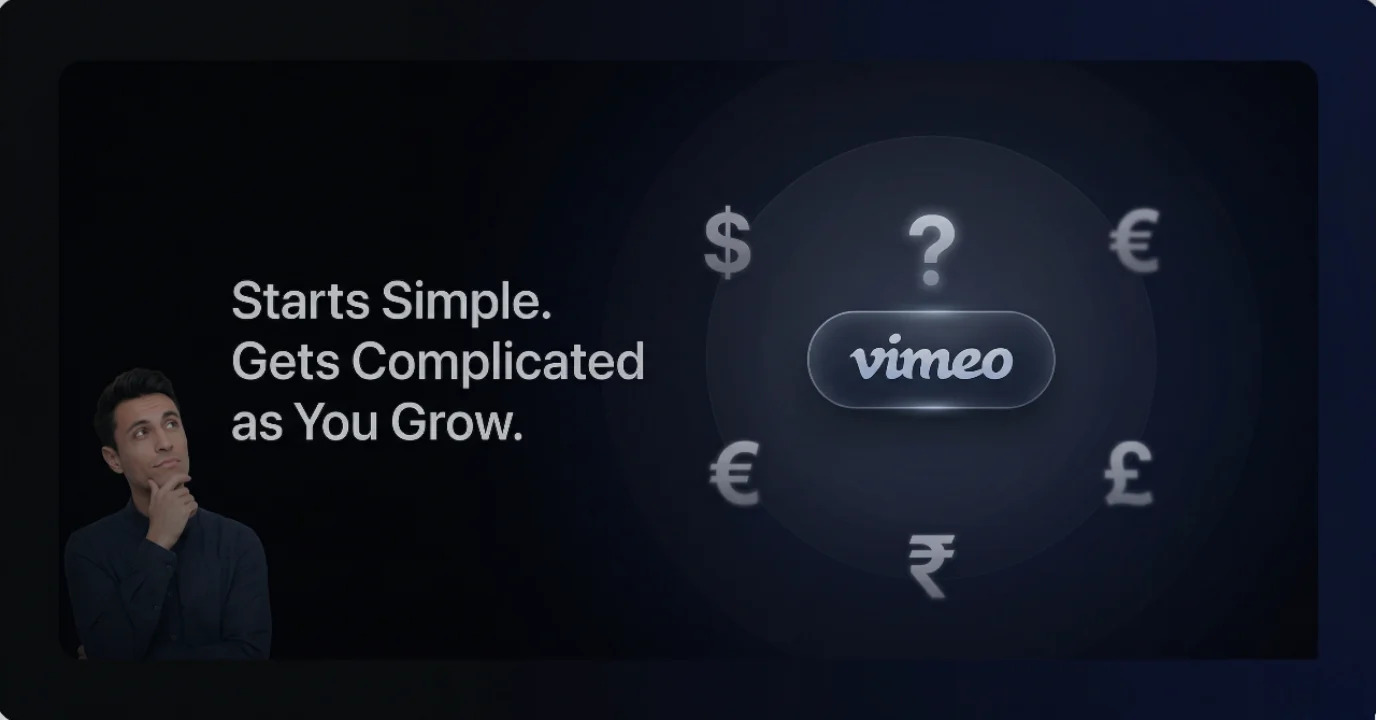
When people search for Vimeo pricing, they usually expect a simple answer.
But the reality depends on what you are trying to build.
If your goal is to launch a subscription-based streaming service, the conversation shifts to Vimeo’s OTT platform. And at first glance, the pricing can look very appealing.
There is no fixed monthly platform fee for Vimeo OTT platform.
If you have zero subscribers, you pay nothing.
For anyone starting a new OTT platform, that sounds like a great deal. This OTT platform pricing model only charges when you begin earning subscribers.
On paper, it feels simple.
But like most pricing models in the streaming industry, the real behavior of the cost structure becomes clearer once your platform starts growing.
And that’s where understanding how Vimeo’s pricing scales becomes important.
How Vimeo OTT Pricing Works
Vimeo’s OTT pricing is built around a simple structure.
Instead of charging a fixed monthly platform fee, the cost is tied to your subscribers and transactions.
For subscription-based streaming services, Vimeo typically charges:
- $1 per subscriber per month
- 2.5% + $0.30 per transaction for payment processing
- 10% + $0.50 per transaction for TVOD purchases or rentals
At first glance, this structure looks very reasonable.
You are not paying a fixed SaaS fee every month. Instead, the platform charges you only when your audience begins to grow.
For someone launching a new streaming service, this feels flexible and low-risk.
But the real impact of this model becomes clearer when you look at how the cost behaves once your subscriber base starts increasing.
What This Looks Like With 500 Subscribers
To understand how Vimeo OTT pricing per subscriber impacts your overall cost, let’s look at a simple example.
Imagine your streaming platform reaches 500 paying subscribers.
If each subscriber pays $10 per month, your monthly revenue would be:
500 × $10 = $5,000
Now apply Vimeo’s pricing.
Platform fee
500 subscribers × $1 = $500
Payment processing fee
2.5% of $5,000 = $125
Even at this early stage, the platform-related cost already reaches about $625 per month.
This is where the pricing model starts to feel different from the initial impression.
While the platform appears to have no monthly cost at the beginning, once your subscriber base grows, the cost begins scaling with your audience.
And as your platform continues to grow, this scaling effect becomes even more visible.
Promotions and Coupons Also Affect Your Costs
Promotions are one of the most common ways streaming platforms grow their audience.
Free trials, discount codes, and limited-time offers are often used to attract early subscribers.
With Vimeo OTT, coupons follow a specific structure:
- 100 coupons per month are free
- Additional coupon redemptions cost $1 each
Let’s look at a simple example.
Example: Running a Promotion Campaign
Imagine you run a campaign offering 50% off and get 300 coupon redemptions.
- First 100 → free
- Remaining 200 → $200 additional cost
If those users continue as subscribers, the $1 per subscriber/month fee also applies.
In simple terms, as your campaigns bring in more users, your platform costs increase along with that growth.
It’s Not Just Subscribers or Coupons — Costs Add Up Elsewhere
Subscriber fees and coupons are just one part of Vimeo’s pricing.
As your platform grows, additional costs can come from:
- Transaction fees on subscriptions and purchases
- Video upload limits, where additional content hours are charged
For example:
- Vimeo includes only 1 hour of upload, after which additional hours cost $99 per 10-hour block
- Transaction and Payment processing fees apply on every subscription or purchase
Individually, these may seem manageable.
But together, they create a model where your platform cost is tied not just to usage — but also to how much your business grows and earns.
Over time, this starts to feel less like paying for software — and more like giving up a share of your growth.
“‘Zero’ Can Cost You More”: Compare Your Expenses
At first glance, Vimeo’s pricing can look attractive, there is no fixed monthly platform fee. If you have no subscribers, the platform appears to cost nothing.
But once your platform begins gaining users, the cost starts scaling directly with your audience through subscriber fees, transaction fees, and other platform charges.
Platforms like Muvi One follow a different pricing philosophy.
Instead of charging based on the number of subscribers or taking a percentage of your revenue, Muvi’s pricing is tied to infrastructure usage such as storage, bandwidth, and encoding. This means your platform cost does not automatically increase every time your audience grows.
Let’s see what happens when you have 500 subscribers and 1000 videos on your platform.
| Platform | Estimated Monthly Cost |
| Muvi One | ~$704 |
| Vimeo | ~$1000 |
Notice something?
With Muvi One, audience growth does not automatically increase your platform fee.
That difference may seem small at first, but it becomes increasingly important as your subscriber base grows.
Beyond Pricing: Platform Capabilities
Pricing structure is an important factor when choosing an OTT platform, but it is not the only one. Teams evaluating streaming platforms also consider operational capabilities such as monetization flexibility, app distribution, and platform control.
In these areas, Muvi One provides significantly more flexibility compared to Vimeo OTT.
For example:
- Revenue Ownership
Muvi One does not take a percentage of your subscription or transaction revenue. Vimeo charges per subscriber and takes a share of certain transactions.
- Payment Infrastructure
Muvi One supports 10+ global payment gateways with customizable checkout, while Vimeo relies on a more restricted payment setup — with payouts handled through its system rather than directly to your account. - App Ecosystem
Muvi One provides 16+ native apps across mobile, Smart TVs, casting devices, desktops, and gaming consoles, allowing broader distribution. Vimeo provides access to 8 apps, primarily available under Enterprise plans. - Customization & Platform Control
Muvi One supports visual design tools, custom templates, and bring-your-own-design capabilities for full platform control.
- Content Protection
Muvi One includes multi-platform DRM, forensic watermarking and other advanced security controls for premium streaming environments.
For a complete breakdown of features, monetization options, and platform capabilities, explore the detailed comparison:
Vimeo vs Muvi One
So, Muvi One or Vimeo?
Vimeo OTT can be a good fit for teams who:
- Want a quick way to launch a subscription streaming service
- Prefer a platform that manages payments and checkout internally
- Are comfortable with pricing that scales with subscriber growth
Muvi One, on the other hand, is often chosen by teams who:
- Want costs tied to infrastructure usage rather than subscriber count
- Prefer full control over revenue, payments, and customer data
- Need flexibility across apps, monetization models, and customization
Neither model is necessarily better for everyone.
But they reflect two very different approaches to building and growing a streaming platform.
Final Perspective
Vimeo’s pricing can look simple when you’re starting out.
But the real question most teams eventually face is how that pricing behaves once their platform begins to grow. Subscriber-based fees and transaction deductions that seem small early on can become much more noticeable as your audience expands.
That’s why many teams evaluating OTT platforms look beyond the starting price and focus on how the platform scales with their business.
If you want to experience how a streaming platform built for scale works in practice, try Muvi One with a 14-day free trial.







Add your comment