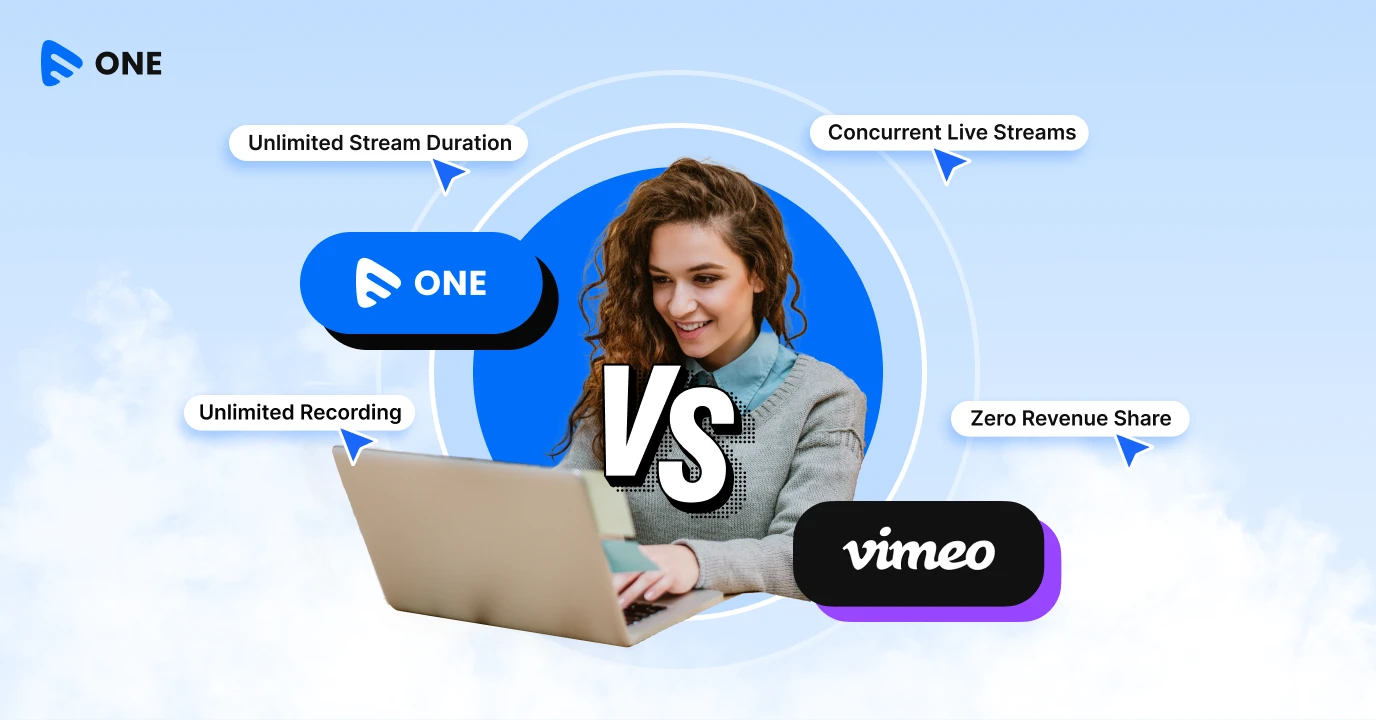
Muvi One vs Vimeo OTT – both promise a faster way to launch an OTT platform without building everything from scratch.
But once real business questions come in — How much will this cost me at scale? Can I control my brand? What happens when my audience grows? — the gap becomes obvious.
Vimeo OTT works well for creators who want to start small and monetize quickly. Muvi One is built for businesses that already think long-term. That difference shows up in pricing, customization, monetization flexibility, and how much control you actually have over your platform.
This blog helps break down Muvi One vs Vimeo OTT from a business perspective — not just features on paper, but how these online video platforms hold up when your OTT product starts growing.
What Is Muvi One?
Muvi One is an end-to-end white-label OTT platform provider designed for businesses that want full control over their streaming service — without building everything from scratch.
Muvi One is fully featured so you get everything needed to launch and run a video streaming platform under your own brand: CMS, hosting, monetization, apps, security, analytics, and global delivery — all under one roof.
Key things Muvi One focuses on:
- Ownership and branding
- Scalability from day one
- Predictable pricing
- Enterprise-grade security
What Is Vimeo OTT?
Vimeo OTT is an extension of Vimeo’s video ecosystem, aimed at creators who want to monetize video content through subscriptions.
It works well if you’re already using Vimeo for hosting and want a simple way to charge viewers. But it’s not designed as a full-fledged OTT infrastructure for complex or large-scale streaming businesses.
Muvi One vs Vimeo OTT: Side-by-Side Comparison
Feature | Muvi One | Vimeo OTT |
Platform type | End-to-end white-label OTT platform | Creator-focused video monetization tool |
Ideal users | OTT businesses, enterprises, media companies | Independent creators, small teams |
Setup model | Fully managed, no-code | Semi-managed |
Branding | 100% white-label | Limited branding options |
Revenue share | No revenue share | Revenue share applies |
Pricing approach | Flat subscription pricing | Platform fee + revenue cut |
Monetization models | SVOD, TVOD, AVOD, PPV, bundles | Mostly SVOD |
Pay-per-view support | Yes | Limited |
Ad-based monetization | Supported | Not native |
Live streaming | Included | Add-on dependent |
Video hosting & CDN | Included | Included |
DRM & security | Multi-DRM, watermarking, geo-blocking | Basic DRM |
API & backend access | Extensive APIs | Limited |
Custom UI/UX control | High | Low |
Mobile apps | iOS & Android | iOS & Android |
TV apps | Roku TV, Fire TV, Apple TV, Android TV, Astro TV, Vidaa TV, Smart TVs | Limited TV support |
Total app ecosystem | 12+ platforms | Fewer platforms |
Payment gateways | Multiple global gateways | Restricted options |
Multi-currency support | Yes | Limited |
Scalability | Built for large-scale OTT | Better for small audiences |
Muvi One vs Vimeo OTT: The Real Differences That Matter
1. Pricing & Revenue Share
This is where most OTT businesses feel the impact first.
Vimeo OTT
- Charges a monthly platform fee
- Takes a percentage of your revenue
- Costs grow directly with your success
Muvi One
- Flat subscription pricing
- No revenue share
- Your earnings stay yours
If you’re building a serious OTT business, Muvi One is often considered the best Vimeo OTT alternative simply because it doesn’t penalize growth.
For more details on pricing, revenue sharing you can browse our page on Muvi vs Vimeo where you get to calculate the real savings and offerings with Muvi One against Vimeo OTT.
2. Monetization Flexibility
Muvi One supports multiple monetization models like:
- Subscriptions (SVOD)
- Pay-per-view (TVOD)
- Ads (AVOD)
- One-time purchases
- Bundles and hybrid models
For more information on monetization of content, read our blog Guide to Streaming Monetization Models.
Vimeo OTT is largely built around subscriptions, with limited flexibility beyond that.
If you plan to experiment with multiple revenue streams — or switch models as your audience grows — Muvi One gives you more room to adapt.
3. App Ecosystem & Device Reach
Audience reach depends heavily on device support. Muvi One offers a whole array of apps like:
Muvi One
- iOS & Android mobile apps
- Apple TV, Android TV, Fire TV
- Roku
- Smart TVs (LG, Samsung)
- Web apps and PWAs
Vimeo OTT
- Supports fewer platforms
- App availability depends on plan and region
For OTT brands focused on scale and global reach, this is a major differentiator in the Muvi One vs Vimeo comparison.
4. Customization & Brand Control
With Muvi One, you control:
- UI/UX
- Player behavior
- App layout
- Content workflows
- Backend logic via APIs
Vimeo OTT offers basic branding (logo, colors), but deeper customization is limited.
If brand experience is part of your value proposition — especially for enterprises or premium content platforms — Muvi One clearly has the edge.
5. Security, DRM & Content Protection
Content protection isn’t optional anymore.
Muvi One includes:
- Multi-DRM (Widevine, FairPlay, PlayReady)
- Tokenized URLs
- Watermarking
- Geo-blocking
- Domain and IP restrictions
For more information on Multi DRM support, go through our blogs:
Decrypting Widevine DRM: All You Need To Know
How Does Apple’s Fairplay DRM Protect Your Videos?
Microsoft PlayReady DRM: A Comprehensive Guide
Vimeo OTT
- Basic DRM
- Fewer advanced security controls
For sports, education, enterprise training, or premium entertainment, Muvi One is built for stricter security needs.
6. Payment Gateways & Global Expansion
Muvi One
- Supports multiple global and local payment gateways
- Better suited for international audiences
- Supports multi-currency pricing
Vimeo OTT
- Payment options are more limited
- Can be restrictive in certain regions
If you’re planning to expand beyond one market, this becomes a critical factor.
7. Scalability & Long-Term Growth
Vimeo OTT works well for:
- Individual creators
- Small teams
- Early-stage subscription projects
Muvi One is designed for:
- Enterprises
- Media companies
- Sports leagues
- Education platforms
- Fast-growing OTT startups
That’s why many businesses evaluating Muvi One vs Vimeo OTT end up switching once scale and customization become priorities.
Muvi One vs Vimeo OTT: Why Customers Move from Vimeo OTT to Muvi One
Many OTT businesses don’t start with migration in mind. They start with Vimeo OTT because it feels simple. But over time, a few consistent pain points push teams to look for a better option.
1. Revenue Share Starts Hurting Growth
As subscriptions grow, Vimeo OTT’s revenue share becomes harder to ignore. Businesses reach a point where giving up a percentage of earnings no longer makes sense. Muvi One’s flat pricing removes that friction completely.
2. Limited Monetization Options
Vimeo OTT is largely subscription-driven. That’s fine early on. But once platforms want pay-per-view events, ads, bundles, or hybrid models, the limitations become clear. Muvi One supports all of these without workarounds.
3. Branding Feels Restrictive
OTT brands want more than a logo swap. They want control over UI, workflows, content discovery, and viewer experience. Vimeo OTT offers basic customization. Muvi One is fully white-label, which is why enterprises often switch.
4. App and Device Expansion Becomes a Priority
As audiences spread across TVs, mobile devices, and regions, limited app availability becomes a blocker. Muvi One’s wider app ecosystem makes it easier to scale without rebuilding the platform later.
5. Businesses Outgrow “Creator Tools”
Vimeo OTT is creator-friendly by design. But enterprises, sports platforms, and education businesses eventually need deeper security, APIs, and backend control. That’s where Muvi One fits better.
This is why Muvi One is often shortlisted as the best Vimeo OTT alternative once growth becomes the goal.
Who Should Choose Vimeo OTT?
Vimeo OTT makes sense if:
- You’re a creator with a small, loyal audience
- You want a quick subscription setup
- You don’t need deep customization or multiple monetization models
Who Should Choose Muvi One?
Muvi One is a better fit if:
- You want full control over branding and UX
- You don’t want revenue-sharing
- You need multiple monetization options
- You plan to scale across regions and devices
- You’re looking for a long-term OTT infrastructure
For many growing businesses, Muvi One becomes the best Vimeo OTT alternative once platform limitations start showing.
Final Verdict: Muvi One vs Vimeo OTT
If you’re testing the waters with a simple subscription model, Vimeo OTT can work.
But if you’re building a serious OTT business — where control, scalability, monetization flexibility, and predictable costs matter — Muvi One clearly stands out.
That’s why more businesses evaluating Muvi One vs Vimeo OTT eventually see Muvi One as the stronger long-term platform.
Need to Migrate your OTT business to Muvi? Click here!
Take a 14 day Free trial or talk to our Sales Team for more clarity!





Add your comment