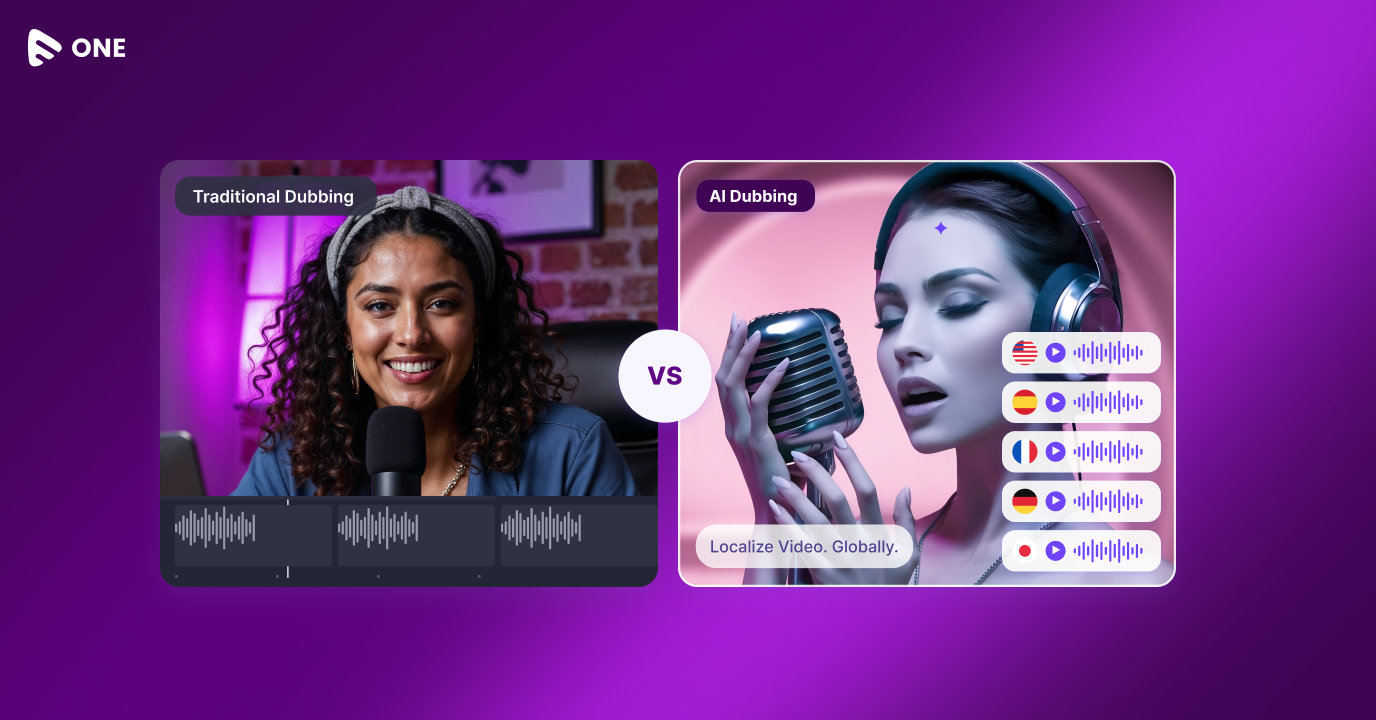
In 2026, content is becoming increasingly global. A Korean drama may find its audience in India, and the latest Marvel movie has to be dubbed into all languages wherever the movie will be shown. The same is true for content types, from educational content to corporate videos. This makes dubbing a very important aspect of any video streaming business.
More than 70% of new OTT growth is now coming from non-English-speaking markets across Southeast Asia, the Middle East, Latin America, and Africa, which means dubbing decisions increasingly sit at the center of a platform’s go-to-market plan rather than as a post-launch afterthought.
In 2026, professional human dubbing runs anywhere from $5 to well over $200 per finished minute depending on quality tier and language pair, while AI dubbing has settled into a $0.10 to $12 per minute range depending on how much human review sits on top of the automated pass. This guide breaks down real, current 2026 pricing for both human and AI dubbing, works through the math behind a typical multi-language rollout, and lays out a practical framework for deciding where each approach fits.
Key Factors That Determine Video Dubbing Cost
Before we do a straightforward comparison of human vs. AI dubbing, let’s first understand exactly what parameters the cost of dubbing depends on and what exactly your requirement is. It will help us to know what actually moves the needle on cost, since the same “per minute” rate can mean very different things depending on the job. Here are certain attributes that may define your dubbing requirements.
Content type & Genre
Some content is easier to dub than others. For example, a corporate training video shot in English can be translated into French or German almost instantly. Scripted drama, on the other hand, is harder and may require a more complex multi-voice model.
Number of Languages To Be Dubbed In
Certain languages such as English and German are easily available. Regional languages cost more for both AI and human dubbing.
Turnaround Time
Probably the most important of all the points. How early do you need the content to be dubbed? Normally, AI dubbing will take less time than human dubbing for obvious reasons. However, at present, AI dubbing will not be as flexible as human dubbing.
Human Dubbing Cost in 2026: A Full Breakdown
Professional human dubbing pricing generally falls into three tiers based on quality and use case.
Tier | Cost per finished minute | Typical use case |
|---|
Entry-level/freelance | $5 – $15 | One-off projects, single language, lower-budget content |
Mid-range professional | $20 – $40 | Corporate and branded content, standard studio setup |
Premium broadcast/studio | $50 – $200+ | Feature films, TV series, high-profile releases |
Language pair also moves the number significantly. English-to-Spanish dubbing typically runs $20–$35 per minute, English-to-Hindi $10–$25, and English-to-Japanese $30–$50, while rare language pairs such as Icelandic or Burmese can exceed $50 per minute simply due to limited voice-talent supply. Premium projects with specialized talent for high-profile film or television can climb past $500 per minute.
A studio quote typically bundles translation and script adaptation, casting, voice-talent session fees, a dubbing director, a recording engineer, mixing and mastering, proofreading, and project management — studio time alone commonly runs $100 to $400 an hour before any of that is added. For a full hour of premium single-language content, all-in production costs commonly land between $5,000 and $15,000, before multiplying across additional target languages.
As costs increase, if you do not have the budget, AI-assisted dubbing using dedicated AI dubbing software can significantly reduce the costs without compromising much on the quality.
AI Dubbing Cost in 2026
Tier | Cost per finished minute | What’s included |
|---|
Tool-only automated dubbing | $0.10 – $3 | Voice cloning, translation, and lip-sync on most modern platforms |
AI + human review / QA pass | $3 – $12 | Bilingual review, cultural-accuracy check, glossary and terminology consistency |
Most creator and business-tier AI platforms price entry access between roughly $0.55 and $2.40 per minute, with volume tiers and annual billing pushing the effective rate lower for larger libraries. Adding a human review layer, recommended for anything customer-facing on a streaming platform, typically adds $2 to $9 per minute on top of the automated cost, which is still a fraction of studio pricing.
AI Dubbing Vs Human Dubbing: A Detailed Comparison
Factor | Human Dubbing | AI Dubbing |
|---|
Cost per minute | $5 – $200+ | $0.10 – $12 |
Turnaround | 2 – 6 weeks | Minutes to 3 days |
Scalability across languages | Linear — one language, one team, at a time | High — many languages processed in parallel |
Voice consistency | Varies by actor availability across markets | Consistent voice profile across all languages |
Emotional range & performance | Highest ceiling for nuanced, dramatic performance | Strong for most content, continually improving |
Cultural adaptation | Deep, director-led adaptation of idiom and tone | Handles most idiom well; benefits from a review pass |
Revision speed | Days to weeks per round | Minutes to hours per round |
Best suited for | Flagship originals, premium scripted content | Catalog-scale localization, fast multi-language rollouts |
Both approaches are strong at what they’re built for. Human dubbing carries the highest ceiling for performance-driven content where a viewer’s emotional connection to a character is the whole point. AI dubbing carries the advantage when the priority is covering more languages, more titles, and more markets without a linear increase in cost or timeline. The same gap between vendor claims and real output shows up anywhere AI sits in the content pipeline, which is why published test data is worth more than a feature list when a shortlist is being drawn up. A hands-on review of undetectable ai, one of the AI writing tools teams run into when they start producing localized copy at scale, works that way: it puts the tool through real inputs and reports what actually came back instead of restating the product page. For a streaming team planning budget across dubbing, subtitling and written metadata, that kind of measured write-up is a far more useful reference point than a spec sheet.
Now comes a very important question. What should you opt for?
Well, there is no one-size-fits-all answer to this question. On the contrary, the answer lies in the requirements. If you dub movies with 40+ characters with different voices and you have the budget to go for it, human dubbing will triumph over the latest AI-led dubbing technology. However, for most general use cases, such as dubbing a physics lecture to a standard YouTube video, AI dubbing will do a fantastic job at much lower prices.
Content is going global, and AI-assisted dubbing can help you stay in the race.
Handle Your Dubbing Needs With Alie AI-Powered Dubbing for Muvi One
For streaming platforms, AI dubbing is most valuable when it is part of the platform itself rather than another tool added to the localization workflow. Muvi One brings AI-powered dubbing directly into your OTT platform through Alie AI, helping you take content from its original language to localized, ready-to-publish versions without managing a separate dubbing pipeline.
Alie AI transcribes your content, translates it into the selected language while preserving context and natural phrasing, and generates studio-quality voiceovers that reflect the original speaker’s tone, pacing, intent, and emotional cues. It can also detect multiple speakers to maintain continuity across a conversation or narrative.
Alie AI’s Dubbing Features
- Language-adaptive transcription so that your content, when translated to another language, retains its original sentiment and context.
- Stunning studio-quality AI voice models that mirror the tone of the original voices, giving a human touch to your dubbed content.
- Automatic subtitle sync as per relevant timecodes so that you do not need to rearrange translated subtitles over voiceovers.
- Alie currently supports bulk dubbing options for 8+ global languages, keeping you market-ready.
- Everything is done within the Muvi One video content management system. No files move out; all edits are done on the timeline itself and can be previewed instantly.
Final Comments
Alie AI powers you to take your dubbing workflow to the next level. When you’re localizing a large catalog, the biggest challenge isn’t dubbing one video — it’s doing hundreds of videos across multiple languages without multiplying your production workload. Alie AI is built for exactly this use case.
Whether you’re localizing a handful of flagship titles, expanding a regional catalog, or preparing hundreds of videos for simultaneous launches across multiple markets. Get a free 14-day trial of Muvi One to learn more.




Add your comment