If you’re searching for how to build your own video hosting platform, chances are you’re not trying to become the next Netflix. You already have a website, app, LMS, or product — and you need reliable video delivery inside it.
The challenge isn’t “hosting videos.” It’s everything behind it: encoding, adaptive bitrate streaming, DRM, CDN delivery, APIs, metadata, and monetization.
This guide breaks down what it actually takes to build a video hosting platform — and how most enterprises do it today without building infrastructure from scratch.
This guide highlights the technical layers required, the real cost of starting from zero, and the practical path to ownership without a multi-year engineering project.
Why Are Businesses Moving Away From YouTube and Vimeo?
The case against free and semi-free video platforms is no longer just about branding. It is a business continuity argument.
YouTube serves ads on your content — including competitor ads. Vimeo’s enterprise pricing has increased significantly, and storage and streaming limits remain a constraint on their lower tiers. Neither platform gives you meaningful control over the player experience, content access rules, or monetization logic. Both serve their own audience retention goals, not yours.
More fundamentally, when your video library lives on a third-party platform, so does your viewer data. Watch time, drop-off points, device behavior, geographic distribution — that data feeds their analytics engine, not yours.
What Does Owning Your Video Infrastructure Actually Mean?
Owning your video infrastructure means controlling the full chain: where content is stored, how it is encoded and transcoded, how it is delivered, who can access it, under what conditions, and what you know about how it is being consumed. It means the player is yours, the embed is yours, and the analytics feed your systems — not someone else’s ad machine.
It does not necessarily mean building every layer from the ground up. In practice, most businesses that “own” their video infrastructure do so by assembling the right SaaS components — a video CMS, a CDN layer, DRM, and an embeddable player — rather than writing infrastructure code.
Who Is Building Their Own Platform — and When?
The businesses making this move fall into a few clear categories. Enterprises with large internal video libraries — training content, product demos, internal communications — that need security, access control, and integration with their existing tools. E-commerce platforms embedding product video that needs to load fast, look branded, and never redirect to a competitor. Digital media companies and course creators who have outgrown the free tier of third-party platforms. And broadcasters or publishers who need to monetize video via ads or subscriptions without giving up revenue share.
The trigger is usually one of three things: a data privacy concern, a branding problem, or hitting a monetization ceiling on a third-party platform.
What Does a Video Hosting Platform Actually Need to Do?
Before scoping out the build, you need a clear picture of what a functioning video hosting platform has to deliver — not as a list of nice-to-have features, but as mandatory infrastructure layers.
What Are the Core Technical Components of a Video Hosting Platform?
A video hosting platform has six non-negotiable layers:
Storage — cloud-based, scalable, and redundant. Videos are large files. A single 4K hour of content can exceed 50GB in raw form. You need infrastructure that does not degrade under volume.
Encoding and transcoding — every video uploaded needs to be converted into multiple formats and resolutions for playback across devices and network conditions. H.264/H.265, adaptive bitrate (ABR), HLS output — these are not optional. A video that buffers on a mobile device is a platform failure.
Content Delivery Network (CDN) — the CDN is what makes delivery fast globally. Without a CDN with sufficient points of presence, a viewer in São Paulo watching content hosted on a US server will experience latency that breaks the experience. Most enterprise-grade platforms require a CDN with at least 100+ global PoPs.
Digital Rights Management (DRM) — if your content has any commercial value, multi-DRM is non-negotiable. Widevine (Chrome/Android), FairPlay (Safari/iOS), and PlayReady (Edge/Windows) cover the major ecosystems. Implementing all three correctly, with license servers and key rotation, is a significant engineering challenge on its own.
A video player — the front-end delivery mechanism. It needs to be embeddable, support ABR, handle multiple subtitle tracks, be customizable to your brand, and work across browsers and devices without plugin dependencies.
Analytics — per-video, per-user engagement data: play rates, watch time, drop-off, device type, geography. Without this, you cannot optimize content or understand your audience.
Build vs. Buy: What Does It Really Cost to Build From Scratch?
An honest engineering estimate for a custom video hosting platform — storage, encoding pipeline, CDN integration, multi-DRM, player, and a basic CMS — starts at $200,000–$500,000 in development costs before you have a production-ready system. That is before security audits, mobile/TV player compatibility, analytics infrastructure, or ongoing DevOps.
Most organizations that go down this path underestimate the scope by a factor of two to three.
What Are the Hidden Costs Most Teams Don’t Budget For?
DRM license server management is ongoing, not a one-time build. CDN costs scale with bandwidth and require contract negotiation as usage grows. Encoding pipelines need capacity headroom for upload spikes. The video player needs to be maintained across browser and OS updates — a Chrome update in 2023 broke DRM playback on dozens of custom-built platforms.
Beyond the technical: compliance. If your platform handles viewer data across jurisdictions, GDPR, CCPA, and regional data residency requirements apply to your video infrastructure. Most custom builds do not account for this until they encounter it.
When Does Building Your Own Make Sense — and When Doesn’t It?
Building proprietary video infrastructure from scratch makes sense for very few organizations: those at the scale of Netflix or Amazon where the platform itself is the product, and where the investment is justified by control at scale.
For the overwhelming majority of businesses — enterprises, media companies, course platforms, broadcasters — the better path is controlled infrastructure without full custom build. That means selecting a professional video hosting layer that handles encoding, CDN, DRM, and CMS, and embedding it into your existing properties via APIs and SDKs. You get the ownership and data control of a proprietary platform without the engineering overhead.
Real-world Example: Enterprise Website Embedding Secure Video
Consider a digital agency managing 30+ client websites.
Each client needs:
- Video embedded across landing pages
- Centralized management of video assets
- Analytics and monetization options
- Fast updates without redeploying the site
Building this independently for each client isn’t scalable.
Instead, agencies rely on infrastructure that allows:
- One backend for all video assets
- Embed codes for distribution
- API-driven workflows
Read More on Encoding: What is Video Encoding & How it Works
How Muvi Optimizes ABR Encoding for High-Quality Multi-Device Streaming
Build Vs Buy Vs Integrate — What’s The Right Approach?
Should you build video hosting in-house? Building from scratch makes sense only if:
- Video delivery is your core product
- You have a dedicated video engineering team
- You’re ready to maintain infrastructure long-term
For most businesses, video is a feature, not the product. That’s why building internally often leads to high engineering costs, ongoing maintenance overhead and fragmented systems.
How Does Muvi Flex Serve as the Infrastructure Layer?
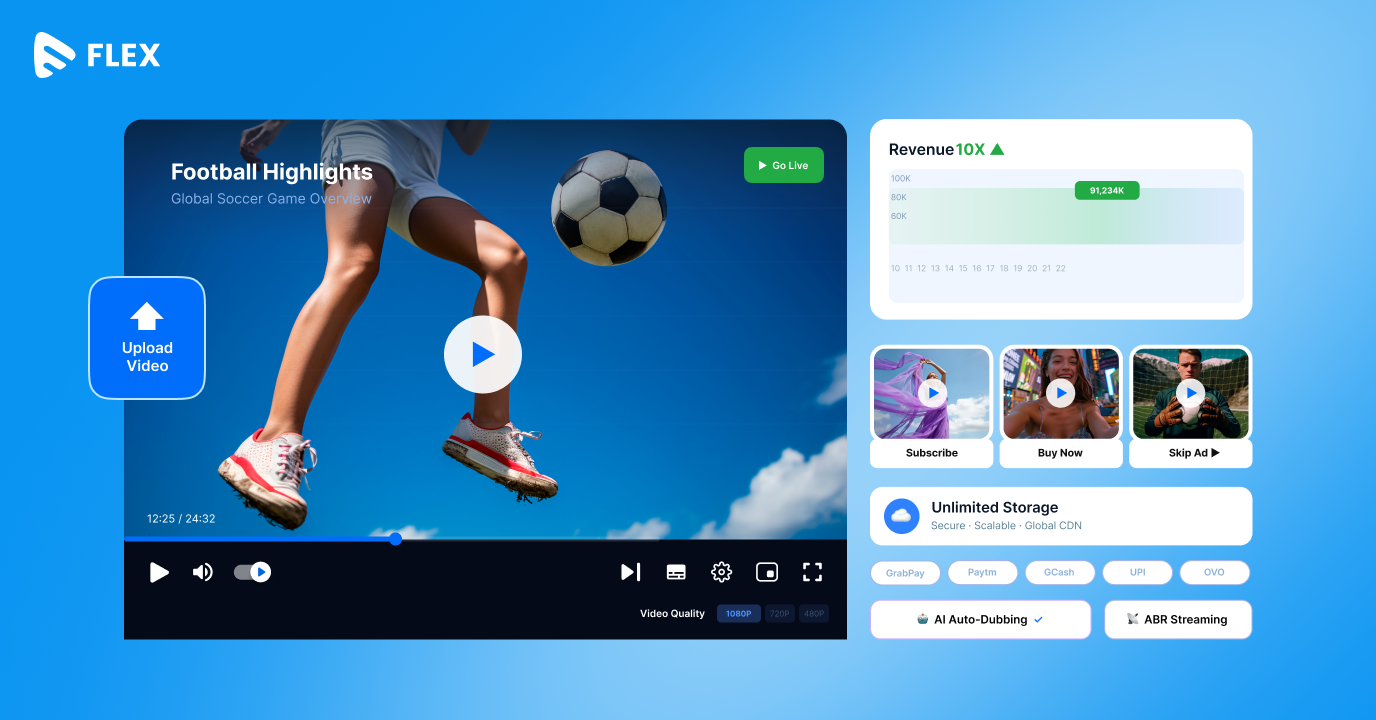
Muvi Flex is purpose-built for this architecture. It is a professional video hosting and CMS platform with no consumer-facing front-end — which is by design. You bring your own website and applications; Muvi Flex provides the infrastructure behind them.
On the storage and delivery side: built-in CDN with 225+ points of presence globally, powered by AWS CloudFront. Encoding and transcoding are handled automatically, with support for ABR, multiple output resolutions, and per-title encoding for bandwidth efficiency. Content is delivered via embeddable HLS links, embed codes, or APIs — directly into your website, app, or any platform you choose.
On security: multi-DRM (Widevine, FairPlay, PlayReady) is built in, not an add-on. Forensic watermarking, geo-blocking, VPN detection, domain restrictions, and anti-screen-capture are all available from the same CMS.
You can try this with a 14-day free trial of Muvi Flex — no credit card required.
Why Is Multi-DRM Non-Negotiable for Business Video?
DRM is not optional for any business hosting content that has commercial, legal, or competitive sensitivity. This includes training content, premium editorial video, sports rights, and any content subject to licensing agreements. Without multi-DRM, content can be downloaded, redistributed, and accessed without authorization. The technology is well-established: Widevine for Chrome and Android, FairPlay for Safari and iOS, PlayReady for Edge and Windows.
The challenge is implementing all three correctly — each requires its own license server integration, key management, and playback validation. For a detailed technical breakdown of how DRM works end-to-end, the Video DRM guide on Muvi’s blog covers the full architecture.
What Comes Next After You Launch?
The platform is live. Content is hosted, DRM is active, and embed codes are integrated. The next priority is analytics — not vanity metrics, but actionable engagement data.
Watch time per video, play rate (how many page visitors actually hit play), average completion percentage, and drop-off points by timestamp are the metrics that tell you whether your content is working. This data should feed your content strategy directly: identify underperforming assets, double down on high-retention formats, and update content that loses viewers in the first 30 seconds.
For platforms at the point where personalized recommendations would improve engagement, Alie’s Suggest IQ feature delivers AI-driven content recommendations based on viewer behavior — without requiring manual curation or data science resources.
The other priority post-launch: understanding your enterprise video platform needs as you scale. Storage costs, bandwidth management, and CDN capacity should be revisited quarterly, particularly if your content library or viewer base is growing.
Conclusion
Building your own video hosting platform does not require building video infrastructure from scratch. What it requires is making a deliberate decision to own the experience layer — the player, the data, the access rules, the brand — while using professional infrastructure for encoding, CDN, DRM, and content management.
The organizations that get this right are not the ones with the largest engineering teams. They are the ones that correctly identify where their competitive advantage lies (the content, the audience, the product) and use robust infrastructure tooling for everything else.
If you are moving away from YouTube or Vimeo and want a professional video infrastructure layer that handles encoding, multi-DRM, CDN, and embedding without building it yourself — Muvi Flex delivers that without setup fees and without locking you into a public platform. Start your 14-day free trial here and explore the full capability before committing.







Add your comment