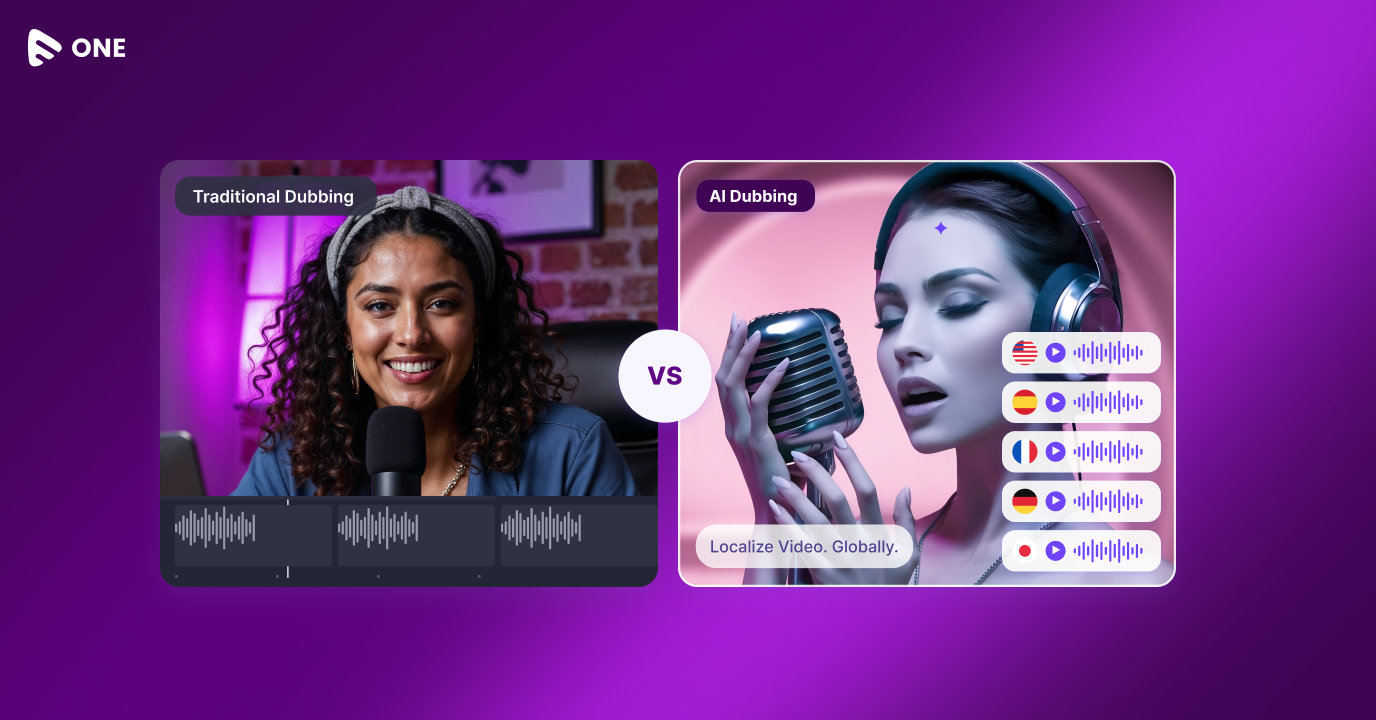
The global dubbing market hit $4.8 billion in 2025 and is projected to hit $6.4 billion in 2026. Over 60% of viewers prefer dubbed content to subtitles. And the average major streaming title now ships in 25 to 40 languages. The audience demand for multilingual content is settled. The question is whether your localization workflow can keep up with it.
Traditional dubbing charges $5,000 to $15,000 per hour of content per language. AI-powered dubbing cuts that by up to 86% and compresses production time from weeks to minutes.
This blog covers how AI dubbing for OTT works, where traditional dubbing falls short, what Alie delivers, and how the numbers shake out for platforms at every scale.
What Is AI Dubbing and How Does It Work?
AI dubbing is the automated process of replacing a video’s original audio track with a translated, AI-generated voice in a new language — while preserving the original speaker’s characteristics: tone, emotion, pacing, and timing.
Where traditional dubbing required a full studio operation — human translators, casting directors, voice actors, sound engineers, and editors working together across weeks — AI dubbing compresses that entire workflow into minutes. A single video can be dubbed into dozens of languages simultaneously.
Under the hood, the process moves through four stages:
- Transcription: The AI listens to the source audio and converts speech to text with speaker identification, capturing multiple voices separately.
- Translation: The transcript is translated into the target language, preserving context, natural phrasing.
- Voice synthesis: Advanced AI voice models generate the dubbed audio, replicating the original speaker’s vocal characteristics in the new language.
- Timing sync: The generated audio is calibrated to match the original video’s timing, ensuring dialogue syncs with on-screen action.
Today, neural network architectures have closed much of the quality gap between AI-generated and human-produced dubbing for most content categories.
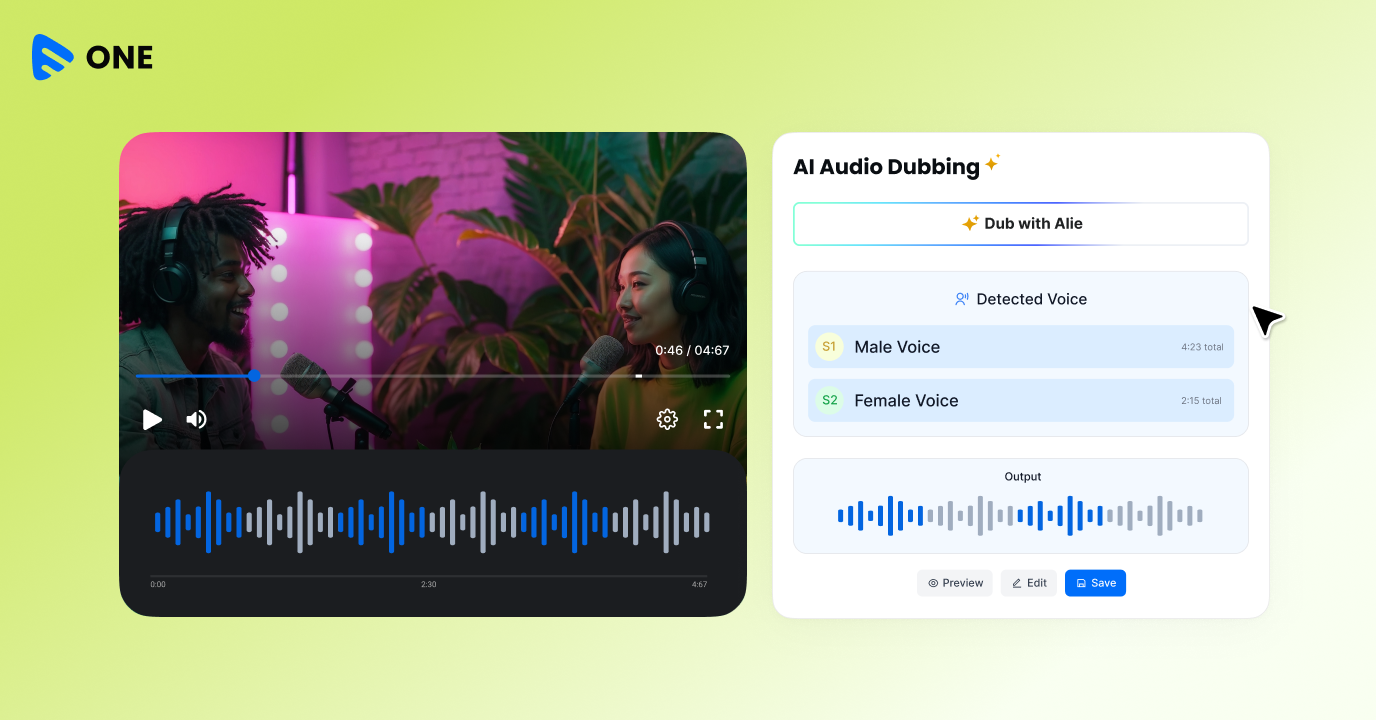
Alie AI delivers this natively inside your CMS — one click to transcribe, translate, and generate studio-quality dubbed audio across languages, with no studios or voice artists involved.
Why Traditional Dubbing Falls Short for Modern OTT Platforms
The traditional dubbing model was built for a different era — one where a single film might reach one or two international markets. That model does not hold up when you are running an OTT platform that needs to go multilingual across ten or twenty markets simultaneously.
Here is what the old approach actually costs:
- Time: A single one-hour episode dubbed traditionally takes two to four weeks from brief to delivery — longer for less common language pairs.
- Cost: Traditional dubbing runs $50 to $200 per finished minute of content. A 10-episode season dubbed into three languages becomes a six-figure project fast.
- Scalability: Every new language requires sourcing new voice talent, new studio sessions, and new production runs. Scaling to 10 or 15 languages is operationally brutal.
- Consistency: Different voice artists across different sessions produce inconsistent results. Character voice, tone, and delivery vary across episodes.
- Update cycles: Any content edit — a corrected line, a revised scene, a content standards change — means starting the dubbing process again from scratch.
A report from Intel Market Research places the global AI video dubbing market at $31.5 million in 2024, projected to reach $397 million by 2032 at a CAGR of 44.4%. The market is moving fast because platform operators are actively replacing traditional dubbing workflows. |
How Alie AI Delivers Studio-Quality Dubbing — Natively Inside Muvi
Alie is the world’s first AI engine built specifically for streaming. Unlike third-party dubbing tools that sit outside your workflow and require file exports, API integrations, and manual round-tripping, Alie is embedded directly inside the Muvi CMS. Your content team dubs without ever leaving the platform.
Here is what Alie’s AI dubbing feature actually does:
- Auto-transcription and translation: Alie analyzes your video or audio content, transcribes the speech in the source language, and intelligently translates it into your chosen language — preserving context and natural phrasing, not just literal meaning.
- AI voice generation: Advanced AI voice models generate dubbed audio that mirrors the tone, pacing, intent, and voice of the original speaker. The output sounds natural, not robotic.
- Regional accents and tonal variations: Alie generates voiceovers rich with regional accents and emotional cues, making the content feel genuinely local rather than generically translated.
- Parallel processing at scale: Dubbing hundreds of videos? Alie processes them in parallel, across multiple languages simultaneously — cutting turnaround time and cost drastically compared to traditional dubbing.
- In-CMS preview and editing: Teams can instantly preview, edit, and finalize dubbed versions right inside the Muvi CMS. No exporting files. No third-party tools. No round-tripping.
Alie also connects dubbing to the broader localization pipeline. The same platform generates accurate subtitles in 130+ languages, translates primary subtitles into 75+ languages in one click, and auto-generates metadata.
Read More: Closed Captions vs Subtitles: How Video Transcription Impacts your OTT Platform
The Business Case: Cost and Speed Comparison
The economics shift significantly when you move from traditional to AI dubbing. Here is a concrete illustration:
A content library of 500 one-hour videos, dubbed into five languages, using traditional methods:
- At $100 per finished minute and 60 minutes per episode: $6,000 per episode per language
- Five languages: $30,000 per episode
- 500 episodes: $15,000,000 in dubbing cost alone
- Timeline: 6–18 months of production across the five languages
With Alie AI dubbing, that same library gets processed in parallel, at a fraction of the cost, with turnaround measured in days — not months.
Voice artists charge a fortune — and for good reason. Alie eliminates that cost line while delivering high-quality results in minutes. |
Key Features to Look for in an AI Dubbing Platform
Here are the capabilities that actually matter when evaluating a platform for OTT use:
- Voice quality and naturalness: The output should sound like a real speaker, not a text-to-speech engine.
- Language breadth: For global OTT deployment, you need coverage across major and regional languages, not just the big five.
- Batch processing: Single-video dubbing is a feature. Bulk processing across a content library is a capability. For platforms with hundreds or thousands of titles, parallel processing at scale is non-negotiable.
- CMS-native workflow: An AI dubbing engine embedded directly in your CMS means your content team dubs and publishes from the same interface — with no file-format juggling.
- Subtitle and metadata integration: The best setups generate dubbed audio alongside subtitles and metadata in a single pass.
- Edit and preview capability: Teams need to review, adjust, and approve dubbed content before publishing. In-platform preview and editing tools close the feedback loop without adding external steps.
Alie meets all of these requirements natively, within the Muvi ecosystem.
AI Dubbing vs. Human Dubbing: Where Each Makes Sense
AI dubbing is not a replacement for every dubbing scenario. Understanding where each approach works best helps you allocate resources correctly.
AI dubbing excels in the following situations:
- Large-volume content libraries where hand-dubbing every title is impractical
- Platforms expanding into multiple new markets simultaneously
- Content that updates frequently and requires re-dubbing on short cycles
- Regional or secondary language markets where full studio budgets are hard to justify
- Educational, documentary, and instructional content where voice naturalness matters but exact character voice matching is less critical
Human dubbing still holds advantages in specific scenarios:
- Premium scripted drama where exact character voice and emotional performance are brand-defining
- Animated content where lip-sync precision must match character facial geometry
- Culturally sensitive markets requiring native speaker judgment on idiomatic adaptation
The most practical approach for most OTT platforms combines both: AI-generated drafts that cover speed and scale, with human quality control on priority titles. Alie’s in-CMS editing capability supports exactly this hybrid workflow — AI generates the base, your team refines where it matters most.
AI Dubbing Trends Shaping OTT in 2026 and Beyond
The AI dubbing space is evolving quickly. The key trends shaping how OTT platforms approach localization over the next two to three years:
- Hybrid AI-human workflows: Most enterprise platforms are moving toward AI-generated first drafts refined by human editors.
- Real-time dubbing for live events: AI systems are beginning to process and dub live sports, news, and event content in near-real time.
- Adaptive cultural localization: Next-generation models are moving beyond word-for-word translation toward adaptive localization — adjusting tone, and cultural references based on the target market, not just the target language.
- Voice consistency across content libraries: AI platforms are developing persistent voice profiles — consistent synthetic voices for recurring characters across a library —
- Integrated localization pipelines: The industry trend is toward full localization stacks where dubbing, subtitling, metadata generation, and distribution prep happen in a single workflow.
How Alie Fits Into Muvi’s Broader AI Ecosystem
Alie is not a standalone dubbing tool bolted onto a streaming platform. It is a native AI engine woven through every layer of the Muvi product suite — and AI dubbing is one capability within a much broader set.
Across the Muvi platform, Alie handles:
Ready to Take Your OTT Platform Global?
AI dubbing for OTT is no longer a future capability — it is available today, inside Muvi, powered by Alie. OTT operators using Muvi can dub entire content libraries into multiple languages without hiring voice artists, booking studios, or waiting weeks for delivery. The result is faster global expansion, broader audience reach, and a content localization workflow that scales with your platform.
Start your free trial or book a demo to see Alie’s AI dubbing in action. Discover how Muvi can help your platform go multilingual in one click. |



Add your comment