In the world of streaming, downtime is not just inconvenient. It is expensive, damaging to your brand, and in some cases, irreversible in terms of subscriber trust.
This is exactly why disaster recovery is a core operational requirement. Whether you run a subscription video service or a live sports broadcaster, your ability to recover quickly from any failure determines how long your business survives.
In this guide, we break down what disaster recovery means for OTT platforms, why it matters, and how Muvi One’s built-in disaster recovery architecture keeps your streaming service protected around the clock.
What Is Disaster Recovery for OTT Platforms?
Disaster recovery (DR) refers to the set of policies, processes, and technologies that allow an organization to quickly restore its IT systems and data after an unexpected failure or disruptive event. For OTT platforms specifically, disaster recovery means ensuring that your video streaming service, content library, subscriber data, and all supporting infrastructure remain accessible — even when something goes wrong.
The failures that trigger a disaster recovery response on streaming platforms include:
- Hardware failure at a data center or cloud node
- Software bugs or corrupted database states
- Cyberattacks such as DDoS (Distributed Denial of Service) floods
- Natural disasters affecting physical infrastructure
- Accidental data deletion by operators or automated scripts
- Traffic spikes that overwhelm under-provisioned infrastructure
A well-designed disaster recovery plan ensures that when any of these events occur, your platform automatically or rapidly switches to backup systems — with minimal loss of data and minimal downtime for viewers.
Why Uptime Matters More Than Ever in Streaming
Streaming audiences have near-zero tolerance for outages. Viewers typically abandon a buffering video within two seconds. If a platform goes completely dark, the churn impact is immediate. And in the case of live events, the damage is permanent.
For OTT businesses, the stakes look like this:
- Every minute of downtime during peak viewing hours can mean thousands of dollars in lost ad revenue
- SLA violations with enterprise clients or distribution partners can trigger financial penalties
- Search engines deprioritize domains with poor availability history, affecting organic traffic
This is why enterprise OTT providers now compete heavily on uptime SLAs. Industry benchmarks have moved from 99.9% (about 8.7 hours of downtime per year) to 99.99% (about 52 minutes per year) and in some cases 99.999% (about 5 minutes per year). Muvi One’s infrastructure is built to deliver at this five-nines level of reliability.
Key Concepts: RTO, RPO, and Failover Explained
Before diving into how Muvi One handles disaster recovery, it helps to understand three fundamental concepts that every streaming operator should know.
Recovery Time Objective (RTO)
RTO is how long your platform can afford to be down before it causes serious business damage. An RTO of zero means your platform switches to backup systems instantly with no interruption. For live streaming events, the acceptable RTO is measured in seconds, not hours.
Recovery Point Objective (RPO)
RPO refers to how much data you can afford to lose in a disaster scenario. If your RPO is 15 minutes, that means your systems are backed up every 15 minutes — and in the worst case, you lose 15 minutes of new data. For VOD libraries and subscriber databases on OTT platforms, a tight RPO protects content metadata, payment records, watch history, and user preferences.
Failover
Failover is the automatic or manual process of switching from a failed primary system to a backup system. In high-availability OTT architectures, failover happens automatically — viewers experience no interruption because traffic is instantly rerouted to a healthy server or region before they even notice a problem.
For streaming platforms, the ideal goal is near-zero RTO combined with a tight RPO — meaning your platform recovers instantly and loses almost no data when a failure occurs. Utilizing AWS components, Muvi One’s disaster recovery plan for video streaming ensures high availability and quick recovery |
Common Causes of OTT Platform Downtime
Here are the most frequent causes of OTT platform downtimes:
Infrastructure failures: Cloud providers and data centers occasionally experience outages affecting entire availability zones. Relying on a single region or a single cloud provider leaves your platform exposed.
DDoS attacks: Streaming platforms are high-value targets for distributed denial-of-service attacks. A sustained DDoS flood can knock an unprotected platform offline within minutes.
Traffic spikes: A viral moment, a major sports event, or a trending content release can drive sudden viewer surges. Platforms without auto-scaling infrastructure suffer buffering and crashes.
Data corruption: Database errors, failed deployments, or malicious insiders can corrupt or delete critical data. Without versioned backups, recovery becomes extremely difficult.
Network failures: ISP or CDN routing issues can cut off a significant portion of your audience even when your own servers remain healthy.
Disaster Recovery vs. High Availability: What Is the Difference?
These two terms are often used interchangeably but they describe different things. High availability (HA) is about designing systems to avoid failures in the first place — using redundant components, load balancers, and automated health checks.
Disaster recovery, on the other hand, addresses what happens when a failure is severe enough to actually impact service — a data center going offline, a major cyberattack, or a catastrophic software failure that affects an entire system. DR is the response plan after a failure; HA is the architecture that minimizes the need for that plan.
Muvi One delivers both.
What to Look for in an OTT Platform’s Disaster Recovery Plan
When evaluating OTT platform providers, disaster recovery capability deserves as much scrutiny as feature sets and pricing. Here are the key questions to ask:
- Does the platform offer automated backups, and what is the retention period?
- Is there a documented RTO and RPO for different failure scenarios?
- Does the infrastructure support multi-region or geo-redundant deployment?
- Is auto-scaling built in to handle traffic spikes without manual intervention?
- Are there regular DR drills or failover tests to validate the recovery plan?
- Does the platform offer multi-CDN support to prevent delivery-layer outages?
- What security measures protect against DDoS and infrastructure-level attacks?
How Muvi One’s Disaster Recovery Architecture Works
Muvi One is built on Amazon Web Services, giving Muvi One access to one of the most resilient infrastructure ecosystems in the world:
Automated Backups with Tiered Retention
Backed by Amazon AWS, S3 Storage and Glacier for tiered backups provide cost-effective, secure, and scalable storage across different recovery time horizons. Frequently needed backups sit in S3 for fast restores, while older historical data is archived in Glacier for long-term retention at lower cost — aligned with Muvi One’s 7, 15, and 30-day backup retention tiers.
Comprehensive Disaster Recovery Strategy
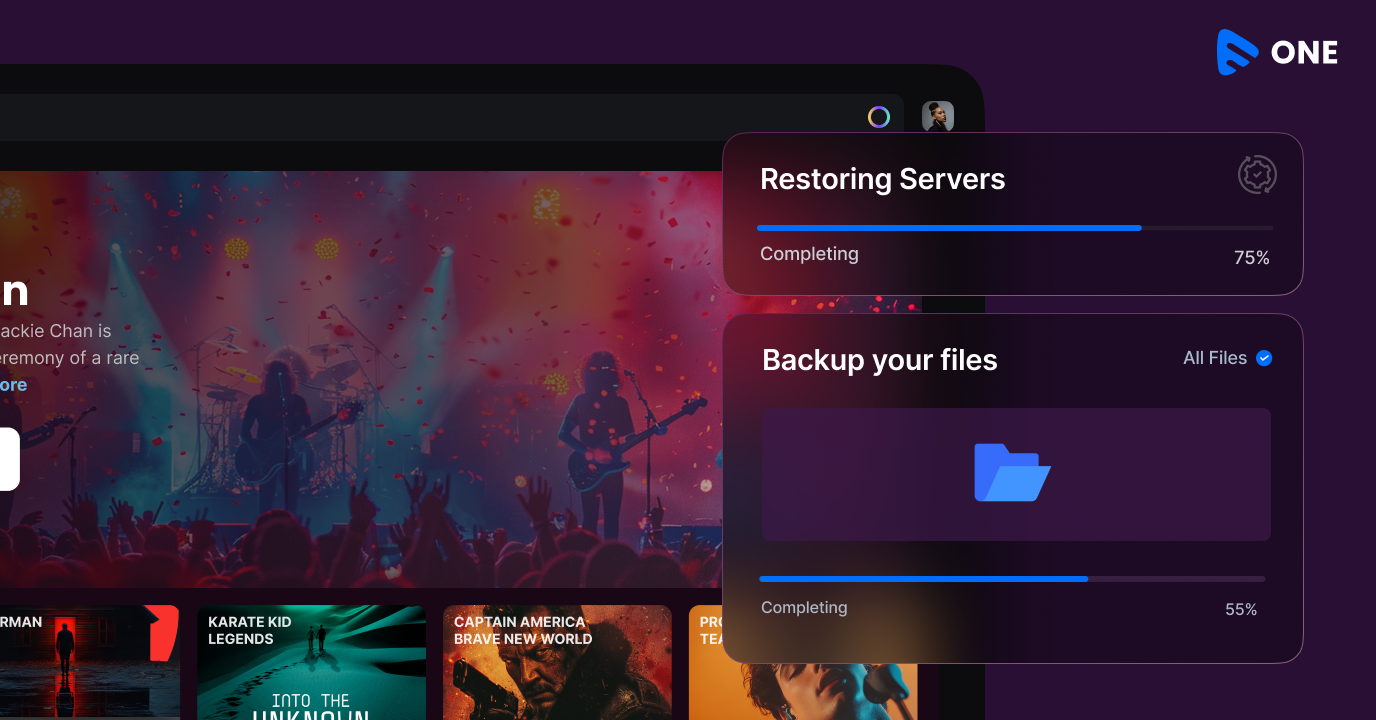
Muvi employs a DR strategy that covers predefined protocols and procedures for restoring servers and applications. These protocols specify exactly how critical services get restored, in what order, and within what timeframes — minimizing guesswork during an incident and accelerating the path back to normal operations.
High Availability Infrastructure
Muvi One’s multi-tenant architecture is designed for high availability from the ground up. Advanced load-balancing technology distributes traffic across multiple server nodes, ensuring that a single server failure does not affect the end-user experience.
DDoS Protection and Network Security
Muvi One employs stringent security measures to protect infrastructure from unauthorized access and DDoS attacks. The platform uses both public and private network segments in a segregated architecture — public networks handle external viewer traffic, while private networks isolate internal system processes and sensitive data exchanges.
Continuous Infrastructure Monitoring
Muvi places strong emphasis on continuous monitoring and optimization of its cloud-based infrastructure. Through regular audits and assessments, Muvi evaluates performance, security, and compliance across all systems.
Multi-CDN Support for Delivery Resilience
Content delivery resilience is a critical dimension of disaster recovery for streaming platforms. Muvi One supports multi-CDN configuration, allowing operators to configure different CDN providers by region.
EC2 Instances
serve as the flexible, scalable virtual servers that power your streaming platform’s compute layer.
Auto-scaling and Elastic Load Balancers
Both work together to maintain optimal performance under varying viewer loads. When traffic surges — during a live event or a viral content moment — auto-scaling adds capacity automatically,
RDS with Multi-AZ Failover
This ensures that your subscriber databases, content metadata, and payment records remain available even if an entire AWS availability zone goes offline.
Snapshots and Amazon Machine Images (AMIs)
This allows Muvi One to capture point-in-time copies of server configurations and data volumes.
Muvi One’s 99.99% Uptime Guarantee
Muvi One offers up to 99.99% uptime on its infrastructure plans. For enterprise-tier subscribers, this uptime guarantee is backed by the underlying AWS infrastructure combined with Muvi’s own redundancy, backup, and failover systems. In practical terms, 99.99% uptime means your platform can experience no more than approximately 52 minutes of total downtime per year.
This level of reliability is critical for:
- Enterprise content platforms
- Live event broadcasters
- Faith and education platforms
- Sports streaming services
Muvi One handles the entire infrastructure stack — cloud servers, storage, transcoding, databases, firewalls, and CDN — so operators focus on content and business rather than backend reliability. |
Conclusion
For any OTT platform — whether you stream to 1,000 subscribers or 10 million — disaster recovery is the foundation that makes everything else possible. Without it, a single infrastructure failure can undo years of audience building, revenue growth, and brand trust.
Muvi One is built with disaster recovery as a core infrastructure capability. With automated tiered backups, a documented DR strategy, DDoS protection, multi-CDN delivery resilience, and AWS-powered high availability, Muvi One gives streaming businesses the confidence to operate at scale — knowing that even in a worst-case scenario, recovery is fast, structured, and built in.
Ready to build a streaming platform with enterprise-grade disaster recovery built in? Start your free trial with Muvi One today or speak with our team to see how our infrastructure keeps your platform protected at every layer. |





Add your comment