A championship fight, a product-launch keynote, a paywalled concert — these events share one hard truth. They happen once, in real time, and the window to protect them is the same window in which they are most valuable. The moment a high-value live stream goes out, someone is already trying to capture it, rebroadcast it, and give it away for free.
For enterprise teams, live stream piracy is not a nuisance. It is direct revenue leakage. Every illegal restream of a pay-per-view event is a ticket you did not sell, and every leaked corporate broadcast is confidential content in the wrong hands. Knowing how to prevent live stream piracy is now part of the job for anyone responsible for a live event that people are willing to pay for.
This post breaks down how piracy happens during a live broadcast, what DRM for live streaming does to stop it, and how watermarking and access controls close the gaps that encryption alone leaves open.
Why Live Streams Are Harder To Protect Than VOD
On-demand video gives you time. You can encrypt it, watermark it, and check it before a single viewer presses play. A live stream gives you none of that. The content is created and distributed in the same instant it becomes valuable, so every protection decision has to be in place before the event starts.
That timing is exactly what pirates exploit. During a major live event, illegal restreams can appear on social platforms and pirate sites within minutes of the broadcast going live. The people running them are not trying to preserve your content for later — they only need it for the length of the event, because that is when demand peaks.
The threats stack up quickly. Viewers share login credentials so several people watch on one paid account. Someone points a camera or a screen recorder at an authorized playback. A restreamer pulls the feed and rebroadcasts it under their own paywall. Each of these leaks the same live moment, and each one costs you a sale you should have made.
What DRM for Live Streaming Actually Does
Digital Rights Management, or DRM, is the foundation of live stream protection. It encrypts your live stream so that only authorized players holding a valid license key can decrypt and play it. Anyone who intercepts the stream without that key gets scrambled, unusable data instead of watchable video.
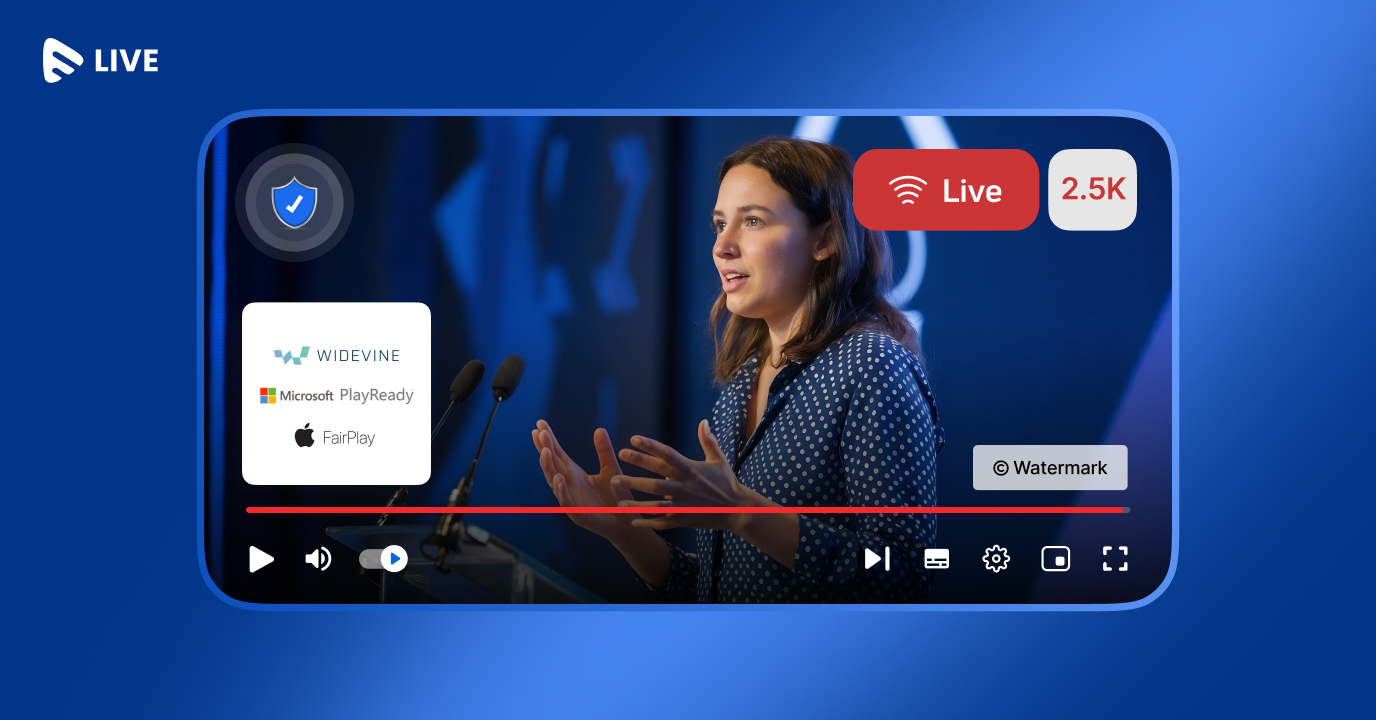
The challenge is that different devices and browsers speak different DRM languages, which is why a multi-DRM approach matters. Muvi Live’s built-in DRM for live streaming supports the three major systems — Widevine, PlayReady, and FairPlay — so protection holds whether a viewer is on Chrome, an Android phone, a Windows laptop, or an Apple device.
Older DRM setups often guarded only against browser-plugin access using a token, which left obvious gaps. Multi-DRM closes them by encrypting and packaging the stream end to end, then delivering it securely to viewers worldwide. The result is a live broadcast that resists hacks and illegal downloads instead of leaving the door open to them.
Protect your next live event from the first second it goes live. Start streaming with built-in multi-DRM. Start Free → |
Watermarking: Finding The Leak When Prevention Is Not Enough
Encryption stops unauthorized access, but it cannot account for an authorized viewer who decides to leak. Someone with legitimate access can still record their screen or point a camera at it. This is where watermarking earns its place, because it turns an anonymous leak into a traceable one.
Visible watermarking overlays end-user details — such as IP address, email, and name — directly onto the video. A viewer who knows their own identity is stamped on the stream is far less likely to redistribute it. You can adjust the transparency and how often the watermark appears, so it deters leaks without spoiling the experience for paying viewers.
Forensic watermarking works invisibly. Muvi Live embeds these markers into the stream as it is delivered through the built-in CDN, and they are built to survive tampering — re-encoding, cropping, filtering, and even camcording. If a pirated copy surfaces, the hidden watermark points to the authorized session it came from, so you can shut down the source rather than guess at it.
Access Controls That Stop Piracy Before It Starts
Strong protection also means controlling where and how your stream can be played. Domain-level control lets you decide which websites are allowed to embed your live player. By adding only trusted sites to an allowed list, you stop unauthorized pages from lifting your player and wrapping your content in their own paywall.
Device coverage matters just as much. Muvi Live’s DRM works across Windows, macOS, iPadOS, Android, and iOS, so protection follows your viewers instead of breaking on whichever device they choose. Pair these controls with your paywall or pay-per-view authentication, and every viewer has to be both verified and on an approved surface before playback begins.
To sum up, no single control prevents piracy on its own, and knowing how to prevent live stream piracy comes down to layering. Each layer covers a gap the others leave behind:
- Encryption (multi-DRM) keeps unauthorized parties out of the stream entirely.
- Watermarking holds authorized viewers accountable and traces any leak to its source.
- Access controls limit where the stream can travel and which devices can play it.
The teams that protect high-value events well treat security as part of the production plan, not an afterthought bolted on once something leaks. Because a live stream cannot be pulled back after it airs, the protection has to be decided, configured, and tested before the first viewer arrives. Read more about the Muvi Live security measures we deploy for our customers.
Protect the value of every live moment with Muvi Live
Live stream piracy will not disappear, but it is manageable when you plan for it. The events worth pirating are the same events worth protecting properly, and the tools to do it — multi-DRM, watermarking, and access control — work best when they are in place before the broadcast begins.
If you are responsible for a high-value live event, build your protection in layers and configure it early. That is how enterprise teams keep the value of a live moment where it belongs: with the audience that paid for it.
Ready to secure your next live event? Start streaming with Muvi Live’s built-in DRM and watermarking. Start Free → |





Add your comment