Physical borders no longer limit content distribution. A streaming platform launched in one country can instantly reach audiences across the world. While this global accessibility creates enormous growth opportunities, it also introduces a major challenge: controlling where content can and cannot be viewed.
Not every video asset is licensed for global distribution. Broadcast agreements, regional regulations, content rights, and business strategies often require organizations to restrict access to specific territories. This is where geo-blocking becomes an essential part of modern streaming operations.
Geo-blocking allows businesses to control access to content based on geographic location, ensuring that videos, live streams, digital assets, and applications are available only in approved regions. For OTT platforms, broadcasters, educational institutions, enterprise video providers, and content owners, geo-blocking has become one of the most important tools for managing regional content distribution.
Muvi One, with its unique geo-block protocols, ensures that your content reaches only where it is meant to be.
What Is Geo-Blocking?
Geo-blocking is a technology that restricts access to content based on a user’s geographic location, typically identified through their IP address. When a user attempts to access a website, video, live stream, or downloadable asset, the platform checks their location and determines whether to grant or deny access based on predefined rules.
For viewers, geo-blocking often appears as a message such as:
“This content is not available in your country.”
Behind the scenes, however, geo-blocking serves a much larger operational purpose. It allows organizations to enforce licensing agreements, comply with regional regulations, protect intellectual property, and manage distribution rights more effectively across global markets.
Why Regional Content Access Matters
Many people associate geo-blocking primarily with entertainment streaming platforms like Netflix or sports broadcasters. In reality, businesses across multiple industries use geo-restrictions to manage content distribution.
The reason is simple: not all content can legally or commercially be distributed everywhere.
Different regions often have different:
- Licensing Agreements
- Copyright Restrictions
- Distribution Rights
- Regulatory Requirements
- Commercial Strategies
Without geographic access controls, organizations may unintentionally violate contractual agreements or distribute content in unauthorized territories. Streaming businesses are among the largest users of geo-blocking technology.
Content licensing frequently operates on a territory-by-territory basis. A broadcaster may own distribution rights for one region while another distributor controls rights elsewhere. Geo-blocking helps enforce those agreements by restricting content availability to authorized territories only. This prevents licensing conflicts and helps content owners maintain compliance with contractual obligations.
Common Business Use Cases for Geo-Blocking
Regional Content Licensing
This is the most common use case. A media company may hold streaming rights for a film in one country but not another. Geo-blocking ensures that content remains accessible only within licensed territories. This protects licensing agreements while preventing unauthorized distribution.
Sports Broadcasting Rights
Sports rights are often sold separately across different markets. A cricket tournament, football league, or international sporting event may have different broadcasters serving different countries. Geo-blocking prevents viewers from accessing streams outside the regions covered by specific rights agreements. Without regional controls, broadcasters risk violating high-value licensing contracts.
Enterprise and Corporate Video Distribution
Many businesses use geo-blocking for internal content rather than public entertainment. Corporate town halls, training sessions, investor communications, and internal broadcasts may need to remain accessible only within approved countries or organizational regions. Geo-blocking adds a layer of access control for enterprise video environments.
Education and Training Platforms
Educational institutions frequently distribute content across different jurisdictions with varying regulatory requirements. Some institutions restrict access to courses, certifications, or learning materials based on region, licensing agreements, or enrollment eligibility. Geo-blocking helps manage these access controls more effectively.
How Geo-Blocking Works
Although the concept sounds complex, the underlying process is relatively straightforward. When a user attempts to access content, the platform identifies the user’s approximate location using their IP address. This location is then compared against a predefined whitelist or blacklist of approved regions.
If the location matches the platform’s access rules, the content is delivered normally. If the location falls within a restricted region, access is denied before the video begins playing. Modern streaming platforms often implement geo-blocking through CDN-level enforcement, allowing restrictions to be applied efficiently before large amounts of video data are transmitted.
Website-Level vs Content-Level Geo-Blocking
Not all geo-blocking strategies operate the same way. Some businesses choose to restrict access to their entire platform, while others apply geo-restrictions only to specific content assets. For example, a filmmaker might decide to build a website on how to make films and keep it exclusive for a particular region.
The same filmmaker might also make another website, this time, though, he wants to list multiple films for the global audience. However, due to some policy-related scrutiny, a piece of content might not be allowed in a particular country. Then, they can simply apply content-level geo blocking.
Platform-Wide Geo-Blocking
In this model, the entire website or application becomes inaccessible within selected regions. This approach is often used when businesses do not operate in specific territories or when legal restrictions apply across the entire platform.
Content-Level Geo-Blocking
Many organizations require more granular control. Rather than restricting the entire platform, they apply geo-blocking only to specific videos, collections, live streams, or downloadable assets. This allows businesses to maintain global platform availability while enforcing rights restrictions for individual content items.
This approach is particularly valuable for OTT businesses managing mixed-content libraries with varying regional rights agreements.
Where Muvi One Fits
Managing geo-restrictions manually across large content libraries can become operationally difficult, especially when businesses distribute content across multiple regions simultaneously.
This is where Muvi One Geo-Block helps simplify regional access management.
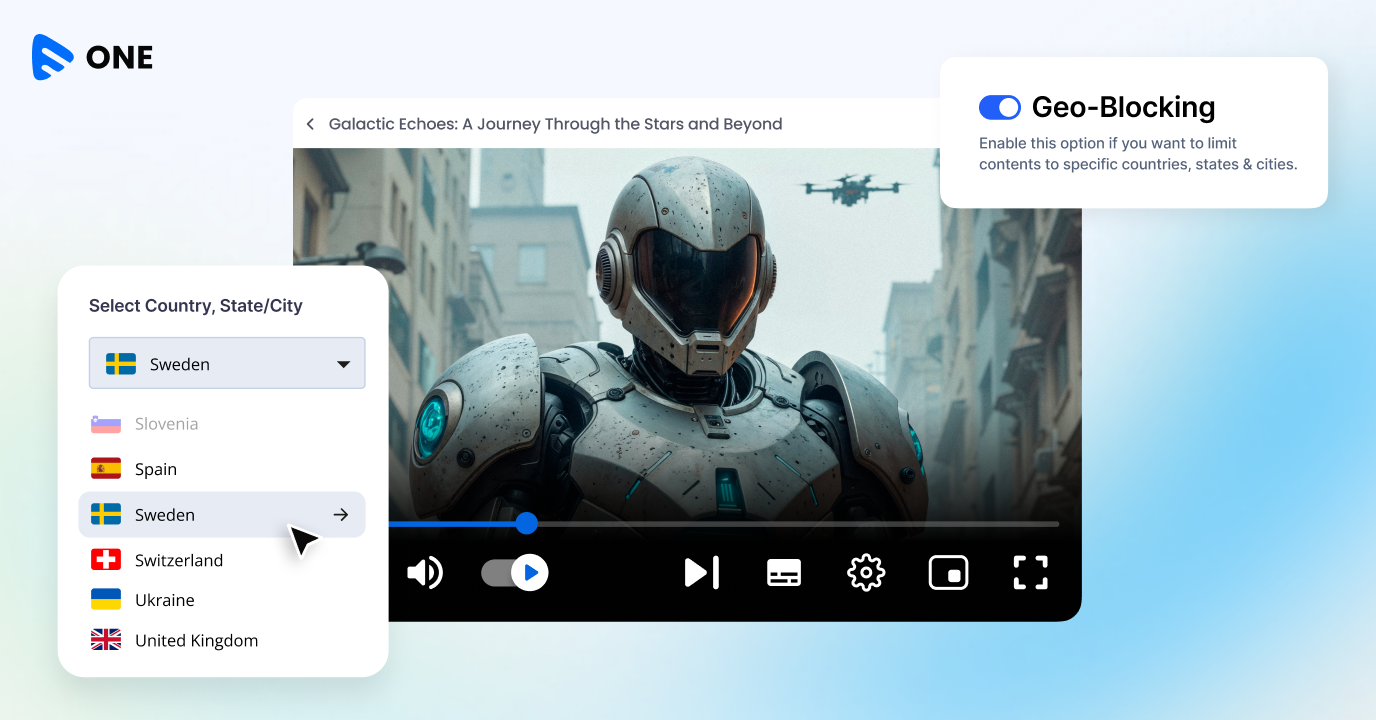
Muvi One allows businesses to implement geo-blocking controls across websites, applications, videos, live streams, and downloadable assets through a centralized platform environment. The feature supports geographic access management using country-based whitelisting and blacklisting, helping organizations control where content can be viewed.
Businesses can:
- Block Entire Websites Or Applications
- Restrict Individual Content Assets
- Control Downloadable Content Access
- Whitelist Approved Countries
- Blacklist Restricted Regions
- Manage Regional Distribution Policies From A Centralized Dashboard
This flexibility allows organizations to align content accessibility with licensing agreements, compliance requirements, and business strategies without creating fragmented workflows. As content distribution becomes increasingly international, businesses need greater control over where and how their content is accessed.
Geo-blocking provides control by allowing organizations to enforce licensing agreements, manage regional distribution rights, protect intellectual property, and comply with geographic restrictions more effectively.
With Muvi One Geo-Block, businesses can implement flexible regional access controls across their streaming ecosystem while maintaining centralized management, stronger compliance workflows, and more precise content distribution control. Get a free 14-day trial to Muvi One today.







Add your comment