The volume of video content published every day has reached a scale that makes traditional navigation methods functionally inadequate. Whether a learner needs to revisit a specific concept in a two-hour training session, or a viewer wants to jump directly to a pivotal scene in a feature film, the experience of manually scrubbing through a timeline is increasingly disconnected from how people expect to find information. The solution lies not in better playback controls, but in fundamentally reimagining how viewers interact with video content itself.
AI search in video represents that reimagination. By applying artificial intelligence to understand speech, visual context, object recognition, and situational cues within a video, platforms can now offer viewers the ability to search inside content the same way they search the internet — with natural language, context, and intent. At the forefront of this capability within the Muvi One ecosystem is Alie, the world’s first streaming-focused AI engine, built specifically to make every video on your platform searchable, discoverable, and deeply interactive.
What Is AI Search in Video?
AI search in video refers to the ability to search the contents of a video file — not just its title, description, or tags — using AI to interpret spoken words, on-screen objects, visual scenes, and situational context.
Traditional video search operates at the metadata level. A platform retrieves results based on what has been written about a video, not what is actually inside it. This creates a significant discoverability gap, particularly for long-form content such as webinars, corporate training modules, recorded meetings, sports events, or feature-length entertainment.
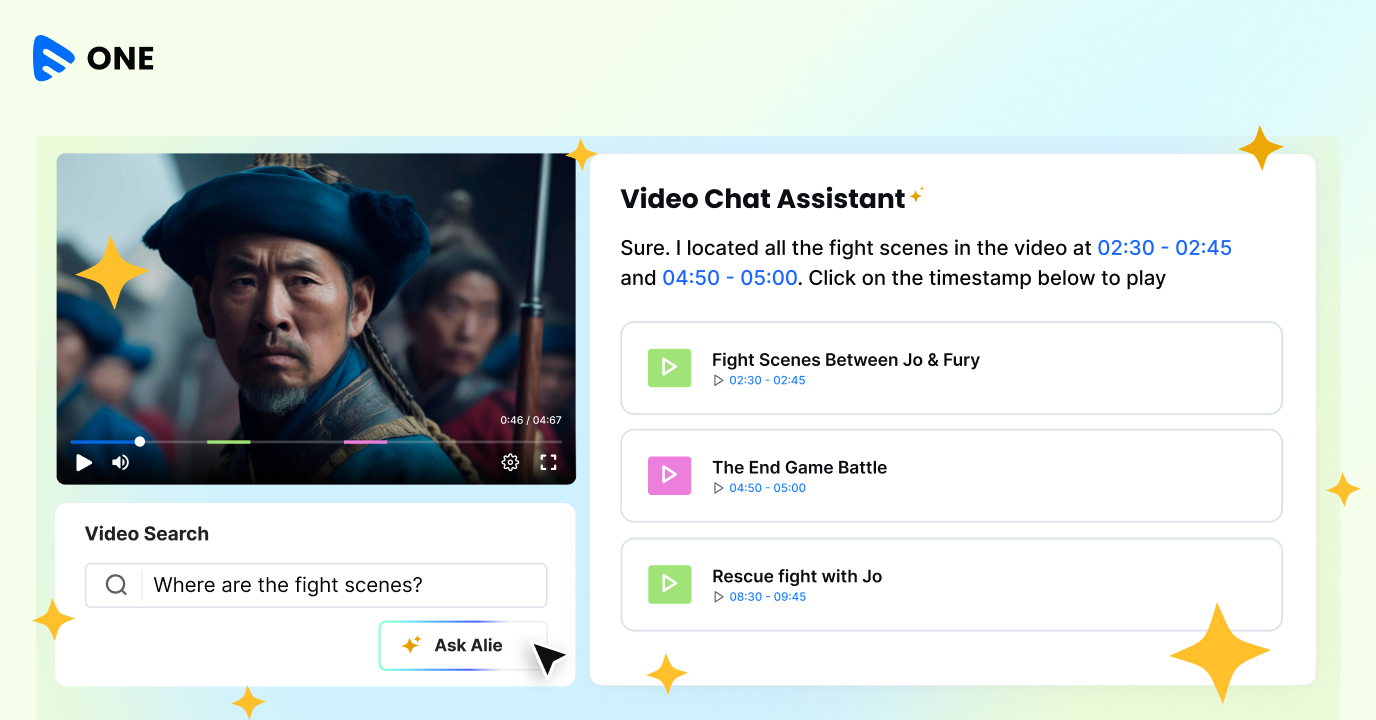
AI search in video closes that gap entirely. Instead of relying on manually written descriptions or keyword tags, AI analyzes the video itself — frame by frame and builds an intelligent index of its contents. When a viewer types or speaks a query, the AI locates the precise timestamp where that moment occurs and delivers a direct playback link.
For administrators and content teams, the ability to search inside video libraries without rewatching hours of footage saves immense time and resources.
How Alie Powers AI Search in Video on Muvi One
Alie is not a general-purpose AI tool retrofitted for video. It is purpose-built for streaming workflows, and deeply integrated into the Muvi One. Its AI search in video capability goes substantially further than simple speech-to-text indexing.
Transcription and Contextual Speech Analysis
Alie begins by automatically transcribing every video uploaded to your Muvi One platform. But transcription alone is insufficient for meaningful search. Alie layers on contextual intelligence — understanding not just what was said, but who said it, when a speaker changes, and how statements relate to one another topically. This means a viewer searching for “the moment the CEO addressed compliance” will find the right segment, even if the word “compliance” appears multiple times throughout the video.
Visual and Object Recognition
One of the defining capabilities of Alie’s AI search in video engine is its understanding of visual content. Alie analyzes frames within a video to identify objects, scenes, and visual situations. A viewer on an entertainment platform might search for “the car chase sequence” or “the courtroom scene.” A corporate user might look for “the slide with the revenue chart.” Alie interprets visual cues to surface these moments directly — no manual tagging required.
This visual intelligence makes AI search in video genuinely useful across content categories, from cinematic storytelling to product demonstrations to security footage review.
Conversational Search
Traditional search requires users to know the exact keyword to retrieve results. Alie’s AI search in the video is conversational. A viewer can search the way they think, using natural language phrases such as:
- “Where did the speaker explain the refund policy?”
- “Show me the part where the demo goes wrong.”
- “Find the Q&A session.”
Alie processes the intent behind the query and matches it against its contextual index of the video, delivering precise, timestamped results. The results appear in a sidebar panel with direct playback links, allowing the viewer to jump instantly to the relevant moment.
Searchable Across the Entire Platform
The power of Alie’s AI search in video extends beyond a single file. Across an entire content library, Alie enables viewers and administrators to search for specific topics, objects, or situations and receive results from multiple videos simultaneously. This transforms a content library from a collection of files into a fully searchable knowledge base.
Alie AI Chat: Taking In-Video Search Even Further
Alongside its AI search in video feature, Alie also offers AI Chat with Video — a conversational interface that allows viewers to engage with a video as if it were a responsive source of information.
Rather than simply retrieving a timestamp, AI Chat with Video allows a viewer to ask multi-part questions, request summaries of specific sections, or explore related topics within the content. Alie analyzes speech, visuals, and context simultaneously to surface the most relevant frames, topics, and timestamps— all without manual tagging.
Real-World Applications Across Industries
The value of AI search in video is not theoretical — it addresses concrete problems across a wide range of industries and use cases.
Corporate Learning and Development Training videos and onboarding content are among the most search-intensive video categories. Employees revisit specific policy explanations, procedural steps, and compliance content repeatedly. With Alie’s AI search in video, a new hire searching “how to process a customer return” is taken directly to that moment in a training video, without requiring the L&D team to create separate micro-content or timestamp every section manually.
Webinars and Virtual Events Webinar recordings are notoriously difficult to navigate. Viewers attending a replay often want a specific presentation segment, a particular speaker’s remarks, or the session where a product was demonstrated. Alie makes every webinar recording fully searchable by topic, speaker, and visual content — dramatically increasing the replay value of event content.
Entertainment and OTT Platforms On entertainment platforms, viewers increasingly want to find specific scenes, characters, or moments without watching through an entire film or series episode. AI search in video enables scene-level discovery — a significant differentiator for OTT platforms competing for viewer attention.
Media and News Archives Broadcasters and media organizations sitting on large archives of recorded content can use Alie’s AI search in video to make those libraries accessible and monetizable, enabling researchers, journalists, and audiences to locate specific footage by subject matter, visual content, or spoken reference.
How Alie’s AI Search Connects to the Broader Muvi One Ecosystem
Alie’s AI search in video capability does not operate in isolation. It is one feature within a comprehensive AI engine that covers the entire streaming workflow.
AI Chaptering by Alie automatically divides long-form video into structured, titled sections with timestamps, making navigation intuitive and improving content indexability for search engines. Each chapter becomes a searchable entry point in its own right.
AI Metadata Generation ensures every video is accompanied by accurate, SEO-ready titles, descriptions, tags, genre, and cast data — generated automatically from Alie’s analysis of audio and visual content. This amplifies discoverability both inside the platform and across external search engines.
Why Alie Is Purpose-Built for Streaming
Many AI tools available to streaming platforms today are generalist models adapted for video use cases. Alie is different. Built by the team at Muvi, with years of experience in streaming infrastructure, Alie is designed from the ground up for the specific demands of video platforms: ingestion-to-playback workflows, real-time viewer interactions, content compliance, and multi-device delivery.
Alie is built on leading large language models and trained on trillions of parameters for natural language and contextual intelligence. It continuously improves based on real-time viewer signals from Muvi’s global video network, meaning its search accuracy and contextual understanding deepen over time.
For platform operators, this translates into AI search in video that works reliably across content categories, languages, and device types — with no manual configuration required to maintain quality.
If your platform is managing growing volumes of video content and your viewers are struggling to find what they need, Alie is the answer. Start a free 14-day trial of Muvi One and experience AI search in video firsthand.
The Future of Video Is Searchable
The trajectory is clear: video content will continue to grow in volume, length, and complexity. Viewer expectations will continue to rise in parallel. The platforms that succeed will be those that treat every video not as a passive media file, but as a searchable, interactive, and intelligent asset.
AI search in video is the foundational capability that makes this possible. By enabling viewers to find any object, scene, or situation within any video — using natural language, without timestamps, without manual tagging — platforms transform the entire content experience.
Alie, as part of the Muvi One ecosystem, delivers this capability today. It is not a roadmap item or a beta feature — it is a production-ready, continuously improving AI engine that is already enabling streaming platforms across industries to make their content more discoverable, their operations more efficient, and their viewers more engaged.
The question for any platform operator is no longer whether AI search in video is necessary. It is whether your platform has the right technology to deliver it. Explore Alie on Muvi One and see what your content can do when it becomes fully searchable.
Take a 14-day Free Trial!








Add your comment