Imagine a situation where you have thousands of hours of movies, TV shows, or educational content in one particular language for your home market. Suddenly, you receive a contract to deliver all of it, basically your entire OTT offering into Chinese or any other language. Translating every video, generating subtitles, and producing dubbed versions for each market can be expensive and time-consuming. Managing these tasks across a growing content library makes the process even more complicated.
This is where Alie powered AI video localization for Muvi One can help. It’s a fact that AI is changing how OTT platforms now operate, and Muvi One is going one step further by offering its accurate, state-of-the-art AI-based content localization services as part of its several Muvi One plans.
This blog talks about how AI video localization on Muvi One can help you expand your OTT business and reach multilingual markets that were otherwise too difficult to penetrate 5 years ago.
What Is AI Video Localization
AI video localization is the process of adapting video content for audiences who speak different languages or belong to different regional markets, using artificial intelligence to automate parts of the workflow. It combines technologies such as speech recognition, machine translation, and AI voice generation to prepare localized versions of existing videos.
Depending on different use cases, AI video localization can include:
- Converting the entire spoken text into text and generating subtitles based on the transcriptions
- Translating those transcriptions into additional languages
- Generating the spoken audio in another language or dubbing that AI powers
- Combining all of it into building ready-to-go OTT platforms for each language and region
It is important to distinguish translation from localization. Translation converts text or speech from one language into another. Localization considers the broader viewing experience, including cultural context, terminology, subtitle presentation, audio preferences, and how language options are delivered through the platform. Alie ensures that the final output of the video is not a direct translation but the closest possible localized version of the foreign language content. For a video streaming business, localization may involve more than translating dialogue. It can also require translated titles, descriptions, categories, and other metadata to help viewers discover relevant content, and with Muvi One, you get all of these right from the CMS screen.
3 Major Components of AI Video Localization Powered by Alie
Getting an entire platform online requires more than just translating content. When you launch your content for a specific region, you do not just go for a language change. There is a change in culture, there is a change in compliance laws, and most importantly, there is a change in the overall perception of content. Here are a few major components that must be taken care of and how Muvi One handles them.
AI Subtitle
Muvi One lets you generate subtitles for your content by detecting the primary language and providing them in real-time formats such as SRT and VTT. The process is fully automated and gives subtitle generation capabilities in more than 79 languages, with further expansion underway.
The subtitle generation is highly accurate, and it also gives you an option to review and refine them should you want to make any last-minute changes within the CMS.
AI Translations
Adding subtitles was the first step. Now that you have a translation for the primary language, the next step is to translate that subtitle into the language of your choice based on the region you are targeting. Alie’s AI-powered subtitle translation helps you translate subtitles faster, reduce manual effort, and make your content more accessible across global audiences in more than 200+ languages.
The translation models used by Muvi have been trained on thousands of hours of videos on the Muvi network, making these translations highly accurate. Lastly, just like subtitle generation, AI translations also come with batch operations support, meaning you can instantly generate translations across a huge number of videos for multiple languages.
AI Dubbing
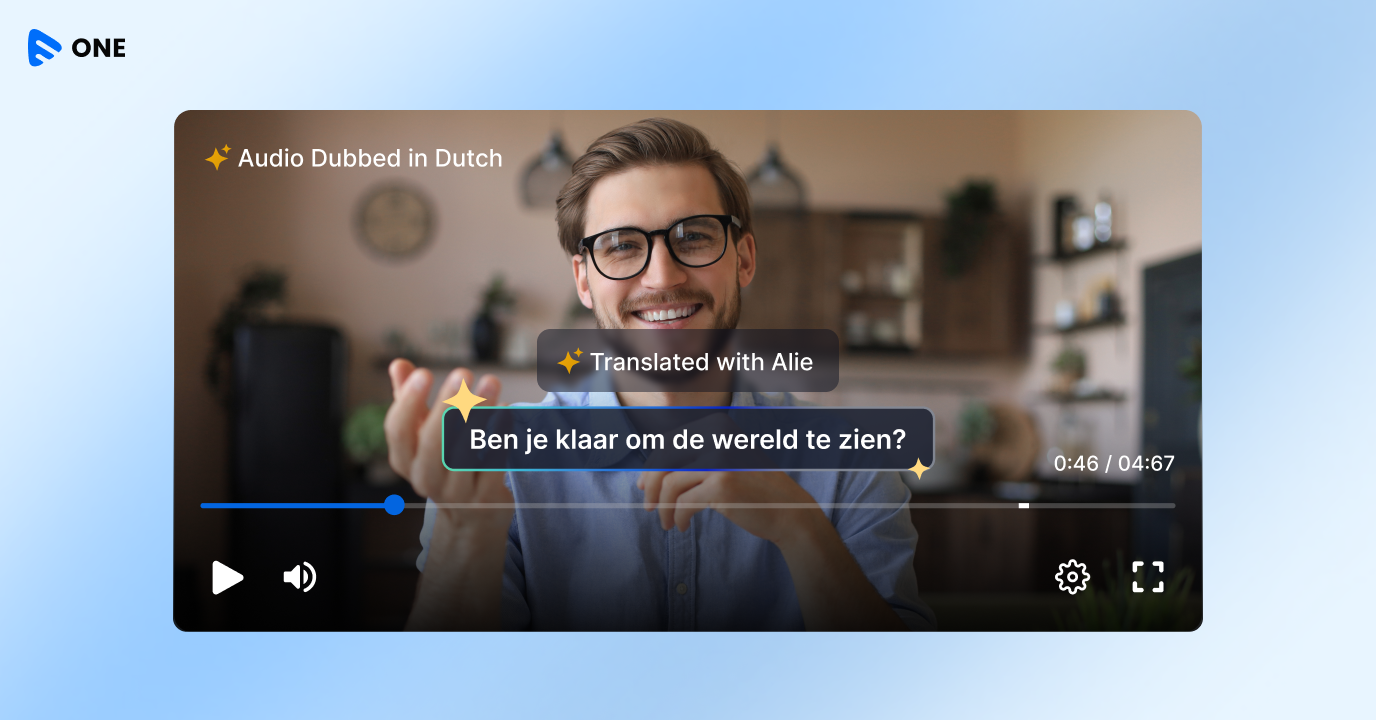
Simply changing subtitles won’t make your video localized. Now the next step towards making your content go local is dubbing the audio, and Muvi One supports and deploys that better than any other platform on the market. Alie AI auto-generates dubbed audio by analyzing your video or audio content. It transcribes speech, translates it into your chosen language & delivers natural-sounding voiceovers with accurate timing.
Dubbing is one of the most expensive things to do when content goes to new regions. Local artists are expensive, and they take a lot of time. Alie’s AI dubbing, on the other hand, can generate realistic voiceovers in multiple languages using advanced AI voice models. Also, AI voice models generate studio-quality dubbing that mirrors the tone, pacing, intent & voice of the original speaker and is in sync with subtitles and timecodes.
Localizing videos for multiple markets involves more than translating dialogue. Video platform owners must generate subtitles, translate them into different languages, create dubbed audio where needed, and manage the resulting assets. Muvi One simplifies parts of this process with Alie, its AI engine designed for video streaming workflows.
The process is quite simple, as we explained above, component-wise. You simply generate subtitles, translate those subtitles into the language of your choice, and then use these subtitles to generate audio-quality dubbing.
Combine all of these, and you get your content localized for any region of your choice.
How Much Does AI Video Localization Cost?
The cost of video localization depends on the number of videos, their duration, the languages required, the localization methods used, and the level of quality assurance involved. Traditional localization may require separate transcription, translation, voice recording, studio production, and editing. Costs can increase significantly when the same process must be repeated across several languages.
AI-powered workflows can reduce some of this manual effort, but the total cost still depends on the tools and services involved.
Common cost components include:
- Transcription and subtitle generation.
- Subtitle translation for each target language.
- AI dubbing and audio processing.
- Human translation review and quality assurance.
- Content storage, management, and delivery.
- Integration and ongoing operational work.
Content Localization Done: What’s Next?
Localizing video content for a new market involves more than translating dialogue, generating subtitles, or dubbing audio into another language. Content that works in one country may need modifications before it can be distributed in another. Differences in cultural expectations, content classification systems, broadcasting standards, and local regulations can affect what you can publish and how you deliver it.
TrueComply by Muvi is an AI-powered video and audio compliance solution that helps streaming platforms, broadcasters, and content distributors identify potentially sensitive material and take appropriate action before publishing.
TrueComply analyzes video and audio to detect issues such as nudity, violence, smoking, alcohol and drug use, profanity, hate speech, and other content that may require moderation. It identifies flagged moments with timestamps, helping reviewers locate specific scenes without watching an entire video from beginning to end. Not just that, you can also create moderation profiles with custom rules and simply apply them to your content, and a new file will automatically show all the changes.
To sum up, AI video localization helps you adapt content for different languages and audiences. Compliance checks help you identify material that may need to be reviewed or modified before it reaches those audiences. Together, they support a more structured approach to international content distribution.
Final Comments
AI video localization gives video businesses a practical way to prepare existing content for audiences who speak different languages. From automatic subtitle generation and translation to AI dubbing, these technologies can simplify several stages of the localization process.
However, scaling localization requires more than choosing an AI tool. Businesses must identify their target markets, audit existing content, establish quality assurance processes, organize language assets, and ensure their video platform can deliver the localized versions effectively. Once this is done, Muvi One takes care of the deployment. Want to learn more?
Get a free 14-day trial of Muvi One today.





Add your comment