Choosing an OTT platform is a major decision for video business owners who want to launch at scale as an internet video streaming service. It’s not just about hosting a video. There are several other factors that contribute in making a great OTT streaming video platform, such as payments, content delivery, security, multi-device access, and more. Muvi One and ViewLift are two established OTT platforms that offer end-to-end solutions for businesses looking to build and operate their own streaming services. However, their platform capabilities, pricing approach, customization options, and ideal use cases differ.
Muvi One and ViewLift are two established OTT platforms that offer end-to-end solutions for businesses looking to build and operate their own streaming services. However, their platform capabilities, pricing approach, customization options, and ideal use cases differ.
Muvi One and ViewLift: Basic Introductions
Muvi One and ViewLift are both OTT streaming solutions but differ greatly in terms of experience and what they offer.
What is Muvi One
Muvi One is an end-to-end OTT platform that enables businesses to launch branded video streaming services without building the underlying technology from scratch. The platform combines video content management, website and app creation, monetization, payment processing, streaming infrastructure, analytics, security, and developer tools in one solution.
Muvi One supports multiple monetization models, including subscriptions, advertising, transactions, and pay-per-view. It also provides native apps for mobile, connected TV, and other supported platforms.
What is ViewLift?
ViewLift is an OTT technology platform designed for media companies, sports organizations, broadcasters, and entertainment businesses. It provides tools for video management, branded applications, content distribution, monetization, analytics, and audience personalization.
ViewLift particularly emphasizes customized OTT experiences, multi-device distribution, integrations, and solutions for businesses with complex content and audience requirements.
Muvi One vs. ViewLift: A Detailed Comparison
Video Content Management
A powerful video content management system is the foundation of any good streaming platform. It defines how well your content is organized within the system and, as it scales, ensures it stays easy to manage.
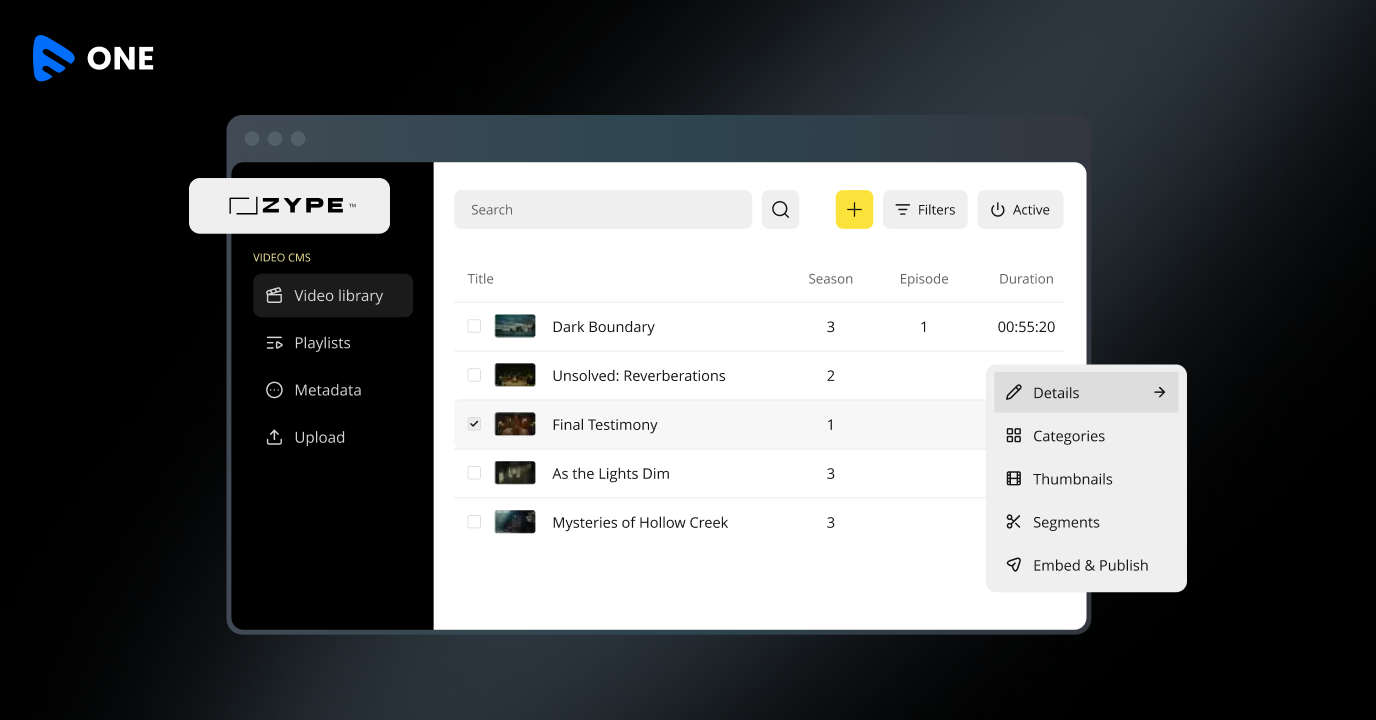
Muvi One provides a centralized video content management system for managing video content, metadata, categories, playlists, users, and content workflows. Businesses can manage their streaming library and distribute content to their websites and applications from a single backend. It works across industries from education to entertainment. Everything that needs to be managed gets managed on a single-screen interface.
ViewLift also provides a video CMS designed to manage large content libraries and support VOD distribution. The platform is particularly geared toward media and entertainment organizations that manage substantial content catalogs.
Streaming Quality & Infrastructure
Streaming quality directly affects viewer experience. Buffering, poor playback quality, or long startup times lead to viewers quitting and an overall downfall in key business metrics. A good streaming platform must provide the best video quality to the end user.
Muvi One supports adaptive bitrate streaming, 4K video, HLS, scalable video delivery, and CDN-based distribution. The platform is designed to deliver content across different network conditions and devices. Not only that, but Muvi One also offers offline viewing capabilities for regions with limited bandwidth access. Muvi’s AWS-backed servers ensure best performance with 99.9% uptime.
ViewLift also supports adaptive streaming and global content delivery, with infrastructure designed for large-scale OTT and multi-device distribution.
Monetization Options
Now lets come to the next crucial factor. How is the platform going to earn?
Muvi One supports several OTT monetization models, including:
- SVOD: Subscription Video on Demand
- AVOD: Advertising Video on Demand
- TVOD: Transactional Video on Demand
- PPV: Pay-per-view
- Hybrid monetization
It also supports subscription management, payment gateways, coupons, promotional offers, and other tools for managing digital revenue. Apart from that Muvi One also offers carrier billing for regions with less credit card penetration to help you bundle all your subscriptions as part of the telephone bill.
ViewLift similarly supports multiple monetization models, including subscriptions, advertising, transactions, pay-per-view, and hybrid approaches.
Multiple OTT Apps Support
Modern viewers can be anywhere. They can watch a soccer game while travelling, and once they reach home, they can resume the same game on their giant 55-inch smart television. OTT platforms are therefore expected to cater to this requirement.
Muvi One enables businesses to launch branded websites and mobile applications across supported mobile, web, and connected TV platforms. This allows a single content library to reach viewers through different devices. From Android apps to iOS devices to smart TV ecosystems, wherever your audience is, Muvi One can help develop an app for you.
ViewLift also focuses heavily on multi-device distribution, supporting branded applications across mobile devices, connected TVs, and other digital platforms. Both approaches allow businesses to create a consistent branded experience beyond the web browser.
Content Security Considerations
Muvi One provides content security capabilities including DRM, encryption, access controls, geo-blocking, watermarking, and other security measures. These capabilities can help content owners protect premium video and control where and how it is accessed. Muvi One is an extremely secure platform that delivers what it claims. Your content is safe with Muvi as your OTT solutions partner.
ViewLift also provides content security and DRM capabilities as part of its OTT technology stack.
AI Capabilities
AI is everywhere, and OTT platforms must not lag behind in this greatest innovation of the century. AI is becoming an increasingly important part of video streaming, from content discovery and recommendations to metadata generation and content workflows.
Muvi has developed and deployed its own streaming-focused AI engine called Alie to extend AI capabilities across several areas of streaming workflows. Depending on the product and configuration, businesses can use AI for metadata generation, content discovery, video chaptering, clip creation, dubbing, compliance, and viewer engagement.
ViewLift also uses AI and machine learning for areas such as content recommendations and audience personalization. Both platforms are incorporating AI into OTT workflows, but their approaches differ. Muvi offers AI capabilities across several content and streaming workflows, while ViewLift places significant emphasis on personalization and recommendations.
Muvi One Vs ViewLift: Price Comparisons
Pricing can be difficult to compare because OTT platforms may charge based on different factors, including platform access, apps, bandwidth, storage, streaming usage, and customization.
One advantage of Muvi One is that it provides publicly available pricing plans. Its plans include different levels designed for businesses at different stages of OTT growth, while larger requirements can be handled through custom enterprise plans. View Muvi One Pricing for more information.
ViewLift, on the other hand, does not publicly list its pricing. This makes the two platforms different from a pricing transparency perspective.
Muvi One Vs ViewLift: Which Is Better for You?
There isn’t a single OTT platform that is ideal for every business. The better choice depends on your content, audience, monetization strategy, and technical requirements. Businesses searching for a ViewLift alternative may be comparing platforms based on pricing, monetization flexibility, customization, apps, security, analytics, and ease of deployment.
Muvi One can be considered a ViewLift alternative for businesses looking for a complete OTT technology stack with video management, monetization, apps, payments, security, analytics, and AI capabilities in one platform. One of the key differences is the pricing approach. Muvi provides publicly available plans, making it easier for businesses to estimate their initial platform investment. ViewLift generally takes a more customized approach to pricing.
The right choice ultimately depends on the type of OTT service you are building and the level of customization and enterprise support you require.
Final Comments
Muvi One is a strong option for businesses looking for an end-to-end OTT platform with multiple monetization options, branded apps, integrated payments, content management, security, analytics, and AI capabilities. Its publicly available pricing can also make initial platform evaluation easier.
ViewLift is particularly compelling for media, sports, broadcasting, and entertainment organizations that need highly customized OTT experiences and complex distribution or personalization capabilities. Before choosing between Muvi and ViewLift, evaluate your expected audience size, monetization model, target devices, geographic markets, content security requirements, integrations, and total cost of ownership.
Additionally, Muvi One also offers a free 14-day trial to help potential customers learn more about the product. Try today. No Credit Card required.



Add your comment