Every video published today must comply with a growing number of editorial guidelines, regulatory frameworks, platform policies, and regional content standards. Whether it’s a movie released across multiple countries, a live sports broadcast, a FAST channel, or an OTT content library, compliance has become an essential checkpoint before content reaches audiences.
For decades, manual review has been the industry standard. Teams of reviewers watched every minute of every video, identified potentially sensitive scenes, documented timestamps, and recommended edits before publication. While this approach worked when content volumes were relatively small, today’s streaming landscape is fundamentally different. Modern platforms process thousands of hours of video every month, making manual review increasingly difficult to scale.
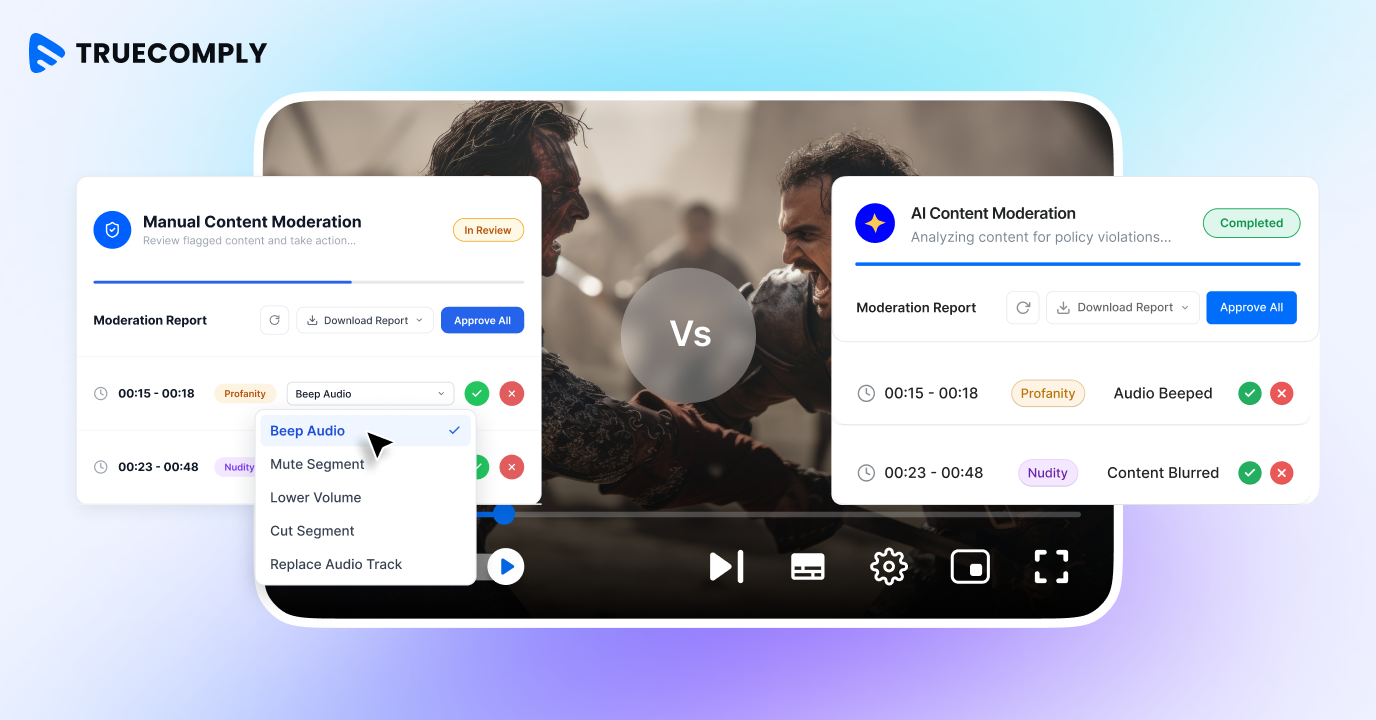
Artificial Intelligence is now changing how compliance teams operate. The conversation, however, should not be framed as manual review versus AI. Instead, the real question is how AI can enhance human reviewers and make compliance operations significantly faster, more consistent, and scalable.
Video Compliance Complexity
The average streaming platform today manages significantly more content than broadcasters did a decade ago.
A typical content library may include:
- Movies and TV shows
- Live sports
- FAST channels
- User-generated content
- Educational videos
- Corporate communications
- Regional content variants
- Multi-language catalogs
Each asset may need to comply with different regulations depending on where it is distributed. At the same time, publishing schedules continue to accelerate. Platforms can no longer afford week-long review cycles before releasing new content. Compliance has therefore become both a quality requirement and an operational challenge.
Read more: Video Compliance Automation: Why Manual Video Compliance is Breaking at Scale for OTT Platforms
How Manual Video Compliance Review Works
Traditional compliance review follows a relatively straightforward workflow. A reviewer watches the video from beginning to end while identifying potentially sensitive content.
They manually document:
- Timestamps
- Scene descriptions
- Policy concerns
- Suggested edits
- Compliance notes
After review, editors implement the required changes before the content is approved for distribution. For years, this workflow has been effective because it places experienced human judgment at the center of every compliance decision.
Context matters. Editorial interpretation matters. Legal interpretation matters. These are areas where human reviewers continue to play an essential role.
The Challenges of Manual Compliance Review
Although manual review provides valuable oversight, it introduces several operational limitations as content volumes increase.
Time-Intensive Workflows
Reviewing a one-hour video generally requires at least one hour of viewing, often considerably longer when documentation, discussions, and multiple review rounds are involved. Multiply this across hundreds or thousands of assets, and compliance quickly becomes a bottleneck.
Reviewer Fatigue
Watching hours of content every day inevitably leads to fatigue. Small but important compliance issues—such as a brief visual, a single offensive word, or a sensitive logo—can easily be overlooked. Consistency becomes increasingly difficult as review workloads expand.
Scaling Requires More People
One of the biggest challenges with manual review is that scaling content typically requires scaling headcount. Publishing twice as much content often means hiring twice as many reviewers. This makes manual-only compliance increasingly expensive.
How AI Video Compliance Review Works
AI approaches compliance differently. Instead of watching content like a human, AI tools such as TrueComply analyze every frame, every spoken word, and every detected object across the video.
It automatically identifies potentially sensitive content before a reviewer even opens the file.
Modern AI systems can analyze:
- Visual content
- Audio tracks
- Speech transcripts
- On-screen text
- Contextual metadata
The result is a structured compliance report rather than an unreviewed video. Reviewers no longer spend most of their time searching for issues. Instead, they focus on validating them.
Read More: Video Compliance Automation: Why Manual Video Compliance is Breaking at Scale for OTT Platforms
Benefits of AI Video Compliance
Speed
AI can analyze hours of video significantly faster than human reviewers. This dramatically reduces turnaround times for compliance operations.
Frame-by-Frame Precision
Unlike human reviewers who watch content continuously, AI evaluates every frame individually. This improves the likelihood of identifying short-duration compliance issues that might otherwise be missed.
Consistency
AI applies the same detection logic across every video. Unlike humans, it does not become fatigued or apply different interpretations based on workload. This improves operational consistency across large content libraries.
Large-Scale Processing
AI can process hundreds or thousands of videos simultaneously. For modern OTT platforms, this scalability becomes increasingly valuable as content libraries continue growing.
Manual Vs AI Video Compliance
Factor | Manual Review | AI-Assisted Review |
Speed | Slower | Significantly Faster |
Scalability | Requires larger teams | Easily scales across libraries |
Consistency | Varies between reviewers | Consistent detection logic |
Frame Analysis | Continuous viewing | Frame-by-frame analysis |
Timestrap Detection | Manual | Automatic |
Metadata Creation | Manual | Automated |
Contextual Judgement | Excellent | Requires Human Validation Sometimes |
Final Compliance Approval | Human | Human |
Introducing TrueComply: Your AI-Assisted Compliance Manager
TrueComply is built around the concept of AI-assisted compliance rather than AI-only moderation. Instead of replacing compliance teams, it helps them work more efficiently by automating the repetitive tasks that consume the majority of review time.
The platform uses AI-powered frame-by-frame analysis to detect potentially sensitive content across visual, audio, and textual elements before human review begins. Following multi-region compliance has never been easy. TrueComply ensures your content is legally compliant and risk-free worldwide.
Key capabilities include:
- AI Video Analysis
- Advanced Violation Detection
- Regional Regulatory Framework-based Moderation Options
- Remote Media Ingestion
- Automatic S&P Checks
- One Click Edits & Prompt-Based Commands
Final Comments
Manual compliance review has served the broadcasting industry well for decades, but modern streaming platforms require workflows that can keep pace with today’s content volumes. AI brings speed, consistency, and scalability to compliance operations, while human reviewers continue to provide the contextual judgment and editorial expertise that automated systems cannot replicate.
Rather than choosing between manual and AI review, streaming platforms should embrace a human-in-the-loop approach where technology accelerates compliance without removing human oversight.
TrueComply helps you automate your operations, accelerate production, and reduce costs in the long run. With TrueComply, you can establish the rules, and TrueComply simply enforces them. With TrueComply, broadcasters, OTT platforms, and media organizations can combine AI-powered frame-by-frame analysis with expert review workflows to build compliance operations that are faster, smarter, and ready for the scale of modern streaming. Get a free 14-day trial to learn more.








Add your comment